

How Massage Can Ease Tight Shoulders and Upper Back Pain

Massage for back and shoulder pain can ease muscle tension and make movement more comfortable. Start with gentle pressure around the upper back and shoulder blades, not directly on a painful joint. If a spot feels sharp or sends pain down your arm, stop and get it checked. For tension that keeps returning, pair bodywork with movement and changes to the habits that strain your shoulders.
I’m Drew Edmondson, owner of Transcending Health, a human restoration and performance center at 1445 Rio Road East, Suite 201 F, Charlottesville, VA 22901. My clinical focus connects back shoulder pain massage with corrective exercise, fascial therapy, and coordinated restorative care to help people move without persistent discomfort.
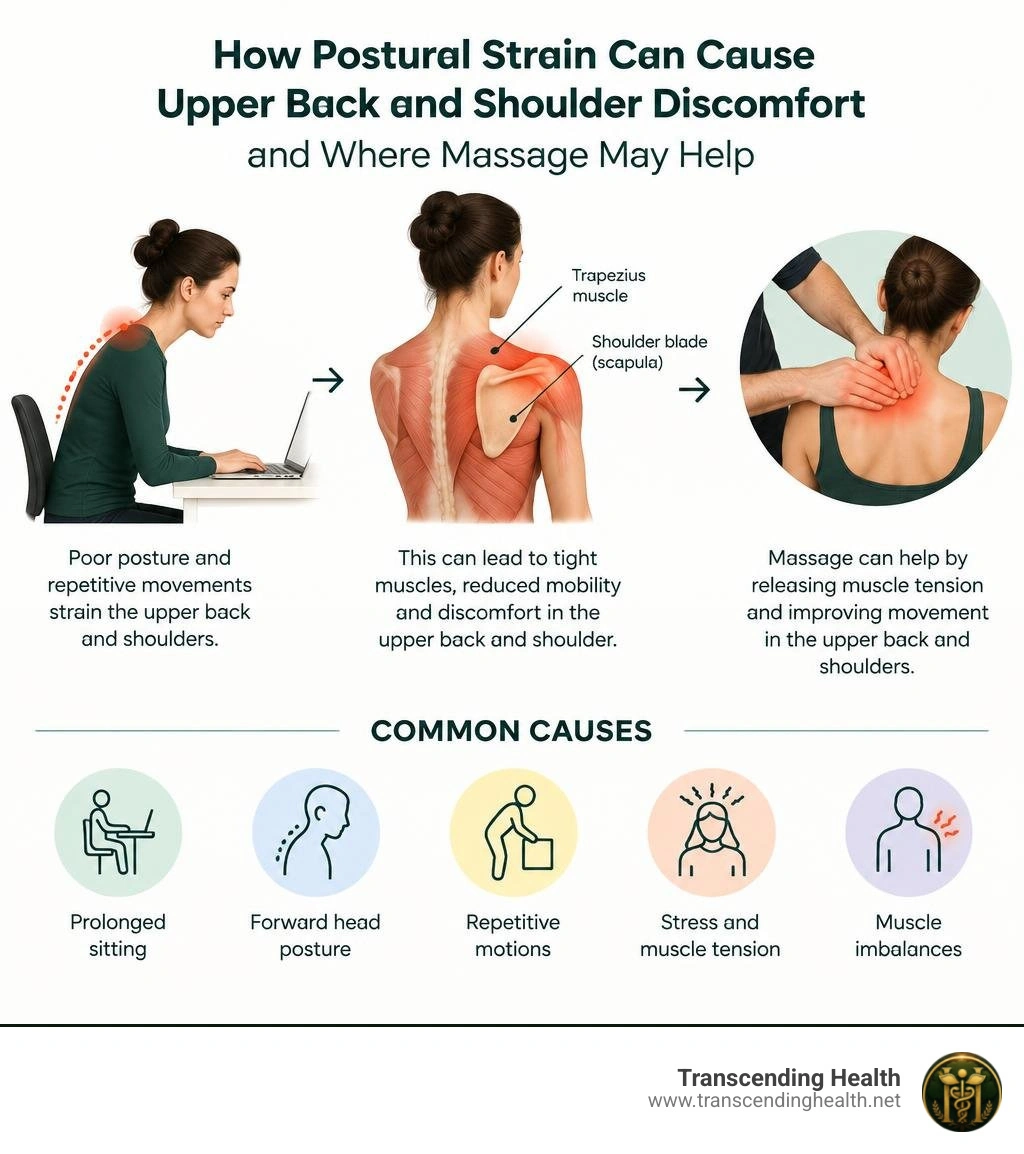
What Causes Upper Back and Shoulder Pain?
Upper body discomfort rarely develops in isolation. The scapula (shoulder blade) rests directly on the ribcage, suspended by a delicate web of muscles rather than a rigid bone-to-bone joint. When daily demands throw this system off balance, both the upper back and the shoulder joint absorb excessive strain. Our desk worker guide for neck and back pain explores how prolonged sitting locks the spine into forward flexed positions, leaving the upper back exhausted from holding the head upright against gravity throughout long workdays.
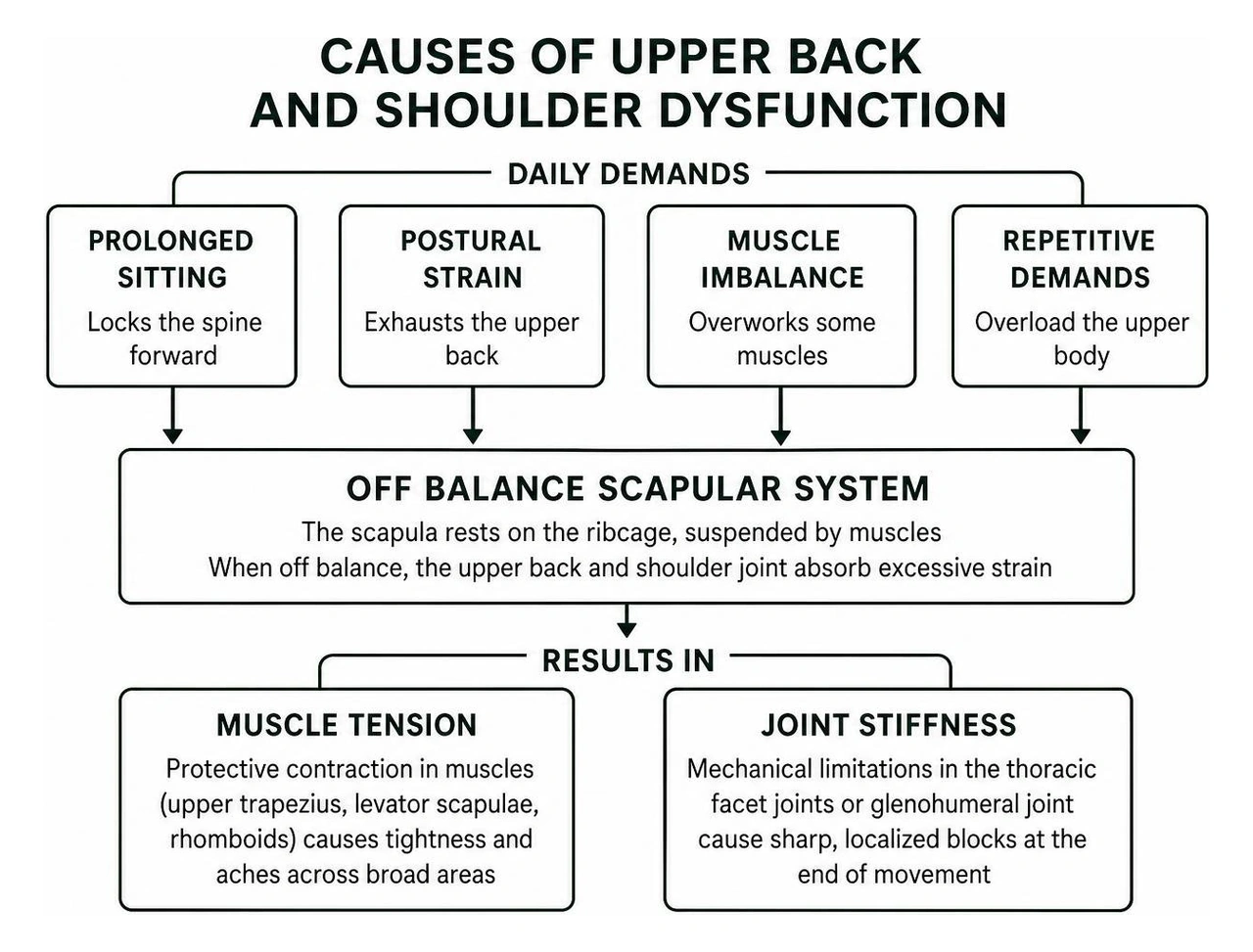
How Muscle Tension Differs from Joint Stiffness
Muscle tension is an active, protective contraction. When muscles like the upper trapezius, levator scapulae, or rhomboids feel overworked or strained, the central nervous system keeps them tight to guard the neck, thoracic spine, and ribcage from perceived instability.
Joint stiffness, by contrast, involves mechanical limitations in the thoracic facet joints, costovertebral junctions, or the glenohumeral joint capsule. While tight muscles feel dull, aching, and broad across muscle bellies, joint restriction produces a sharp, localized block at the end range of movement. Restorative bodywork relieves muscular hypertonicity so underlying joint mechanics can normalize smoothly without constantly fighting stiff surrounding soft tissue.
Postural Strain and Common Injury Triggers
Everyday movement patterns place continuous stress on the entire shoulder girdle. Sitting slumped with rounded shoulders and a forward head carriage alters how the rotator cuff tendons pass beneath the bony acromion arch. Over time, this mechanical pinching can lead to rotator cuff irritation, subacromial impingement, or contribute to conditions like adhesive capsulitis (frozen shoulder). Addressing postural strain early through focused soft-tissue work prevents these protective muscle spasms from turning into chronic movement restrictions that limit your daily physical activities.
Which Back Shoulder Pain Massage Techniques Work Best?
Different tissue layers require specific therapeutic approaches. We use targeted hands-on modalities to restore tissue pliability, reduce mechanical friction, and calm hyperactive nerve signaling across the upper body.
| Technique | Primary Mechanism | Best Suited For | Expected Sensation |
|---|---|---|---|
| Deep Tissue Massage | Cross-fiber friction and slow, deep strokes | Chronic muscle adhesions and thick postural tension | Firm pressure with gradual tissue release |
| Trigger Point Therapy | Ischemic compression on hyperirritable spots | Referred pain and localized muscle knots | Intense, focused ache that fades as tension drops |
| Myofascial Release | Sustained, low-load fascial stretch | Broad movement restrictions and structural stiffness | Gentle, warming sensation of tissue unwinding |
Deep Tissue and Medical Massage for Upper Back Adhesions
Chronic postural tension and repetitive movements create microscopic adhesions within muscle fibers and between dense fascial planes. Our deep tissue massage targets these dense areas along the spine, rhomboids, and shoulder blades. By applying controlled friction across tight muscle fibers, we help improve local circulation, break up restrictive fibrous tissue, and restore normal sliding between overlapping muscle groups.
How Back Shoulder Pain Massage Releases Stubborn Trigger Points
Trigger points are hyperirritable nodules within taut bands of skeletal muscle fibers. A classic example is found on the infraspinatus muscle over the shoulder blade—often referred to clinically as Spot 14.
When compressed, this spot frequently refers a deep, persistent ache into the front of the shoulder, down the arm, or into the wrist, mimicking joint pain or bursitis. Focused ischemic compression calms the local contraction knot, reducing both local tissue sensitivity and referred ache throughout the shoulder girdle.
Myofascial Release and Fascial Counterstrain for Mobility
Fascia is the continuous connective tissue matrix surrounding every muscle, nerve, blood vessel, and bone. When prolonged strain dehydrates this network, muscles become locked in shortened, restricted positions. Gentle modalities like myofascial release and fascial counterstrain therapy use sustained, gentle positioning to release deep reflex muscle guarding. This thoughtful approach softens fascial drag without triggering protective tension spikes in sensitive clients.
What Does Research Say About Massage for Shoulder and Back Pain?
Evidence on massage for musculoskeletal discomfort is condition-specific. A small randomized clinical trial compared massage with standard medical care for chronic pain involving the back, neck, shoulders, head, and limbs. The authors reported lasting improvements in the massage group at follow-up, while noting that the findings needed replication.

The National Center for Complementary and Integrative Health notes that massage has been studied for neck and shoulder pain, but the strength of evidence and potential benefits vary by condition. The American Massage Therapy Association also explains that shoulder and back pain can involve muscles, tendons, nerves, and joints, so a careful assessment matters before choosing hands-on care. Care should be adjusted for symptoms, medical history, and the source of pain instead of following a one-size-fits-all routine.
Short-Term Relief Versus Long-Term Functional Recovery
Massage creates immediate pain modulation by stimulating parasympathetic tone, reducing systemic stress hormones, and boosting local arterial and venous blood flow. However, lasting relief requires pairing targeted tissue work with nervous system down-regulation, postural awareness, and progressive movement retraining. This holistic combination ensures that the range of motion gained on the treatment table translates into lasting structural support during daily activities, athletic pursuits, and occupational tasks.
How Can You Perform Self-Massage for Shoulder and Back Tension at Home?
Between professional sessions, targeted self-care helps keep muscle tissue pliable, stimulates local circulation, and reduces daily tension buildup.

Targeting the Infraspinatus and Scapular Ridge
To release the infraspinatus and upper back knots at home, follow these steps:
- Position the Ball: Place a firm rubber ball (such as a lacrosse ball or squash ball) between your shoulder blade and a flat wall.
- Locate the Tender Spot: Lean gently into the ball and slowly roll until you find a sensitive spot on the flat bone of the shoulder blade below the bony ridge.
- Apply Sustained Pressure: Hold static, comfortable pressure on the point for 30 to 60 seconds while taking slow, diaphragmatic breaths.
- Avoid Sharp Pain: If you feel numbness, tingling, or sharp shooting sensations down your arm, step away immediately and reposition the ball to a safer spot.
What Does a Professional Restorative Bodywork Session Involve?
At Transcending Health, a session begins with a comprehensive consultation and movement assessment to identify structural imbalances, postural compensations, and restricted movement patterns across the neck, ribcage, and shoulder girdle.
Our personalized care plans blend hands-on therapies like restorative bodywork and massage with corrective exercise, mobility training, and advanced recovery modalities. For stubborn tissue irritation and chronic pain, we can incorporate non-invasive tools such as SoftWave acoustic wave therapy, focused cryotherapy, or orthopedic laser therapy to accelerate tissue recovery.
Customizing Back Shoulder Pain Massage for Specific Injuries
No two shoulder injuries present identically:
- Rotator Cuff Irritation: Bodywork focuses on releasing secondary tension in the pec minor, latissimus dorsi, and upper trapezius while protecting healing tendons.
- Frozen Shoulder (Adhesive Capsulitis): Gentle fascial and rhythmic techniques improve fluid dynamics, joint nutrition, and mobility within tolerable comfort limits.
- Scapular Dyskinesis: Manual therapy calms overactive neck muscles so lower stabilizing muscles can be properly retrained through corrective exercise.
Frequently Asked Questions About Upper Back and Shoulder Bodywork
How often should you receive massage for chronic upper back and shoulder pain?
For persistent chronic tension, an initial cadence of one session per week for two to four weeks helps break the cycle of muscle guarding and tissue restriction. Once mobility improves and baseline discomfort decreases, bi-weekly or monthly maintenance visits support long-term alignment, postural resilience, and ongoing injury prevention.
Can deep tissue massage worsen an acute rotator cuff injury?
Yes, aggressive deep tissue work applied directly over an acutely torn or inflamed rotator cuff tendon can increase local inflammation and tissue damage. Acute injuries require gentle, non-irritating modalities, focused cryotherapy, and work on surrounding compensatory muscles rather than direct deep pressure on the damaged fibers.
How do trigger points in the shoulder blade cause pain in the arm?
Trigger points create sensory referral patterns via shared neurological pathways in the spinal cord. When a hyperirritable spot in the infraspinatus muscle is compressed, the central nervous system often maps that nociceptive signal along the dermatomes of the shoulder and arm, creating a deep ache that feels distant from the actual muscle knot.
Conclusion
Restoring comfort to your upper back and shoulders requires addressing both tissue tension and the movement habits that create it. If you are ready to address chronic tightness and move without restriction, schedule a bodywork consultation at Transcending Health in Charlottesville, or contact us at 434-465-2905 or info@transcendinghealth.net.