What Is Fascial Counterstrain, and Who Might It Help?

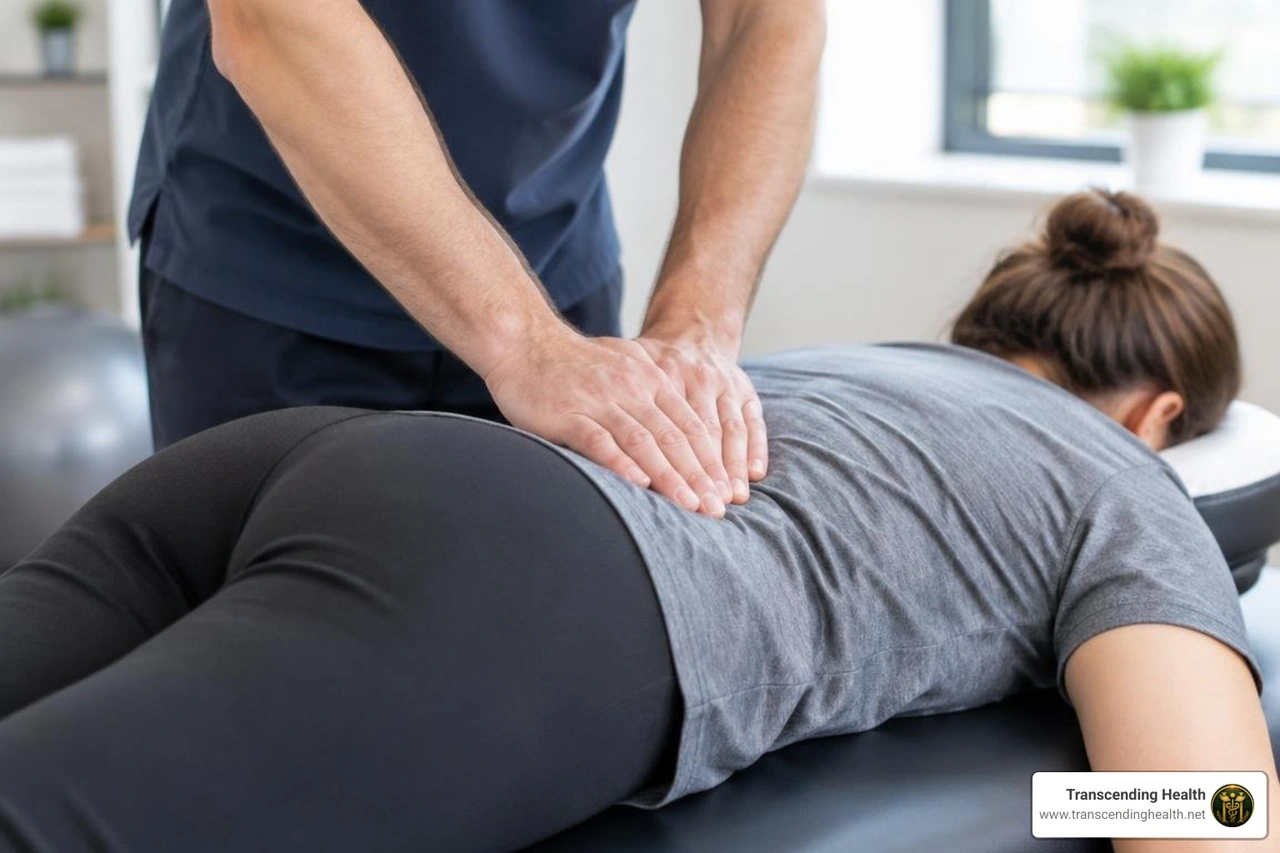
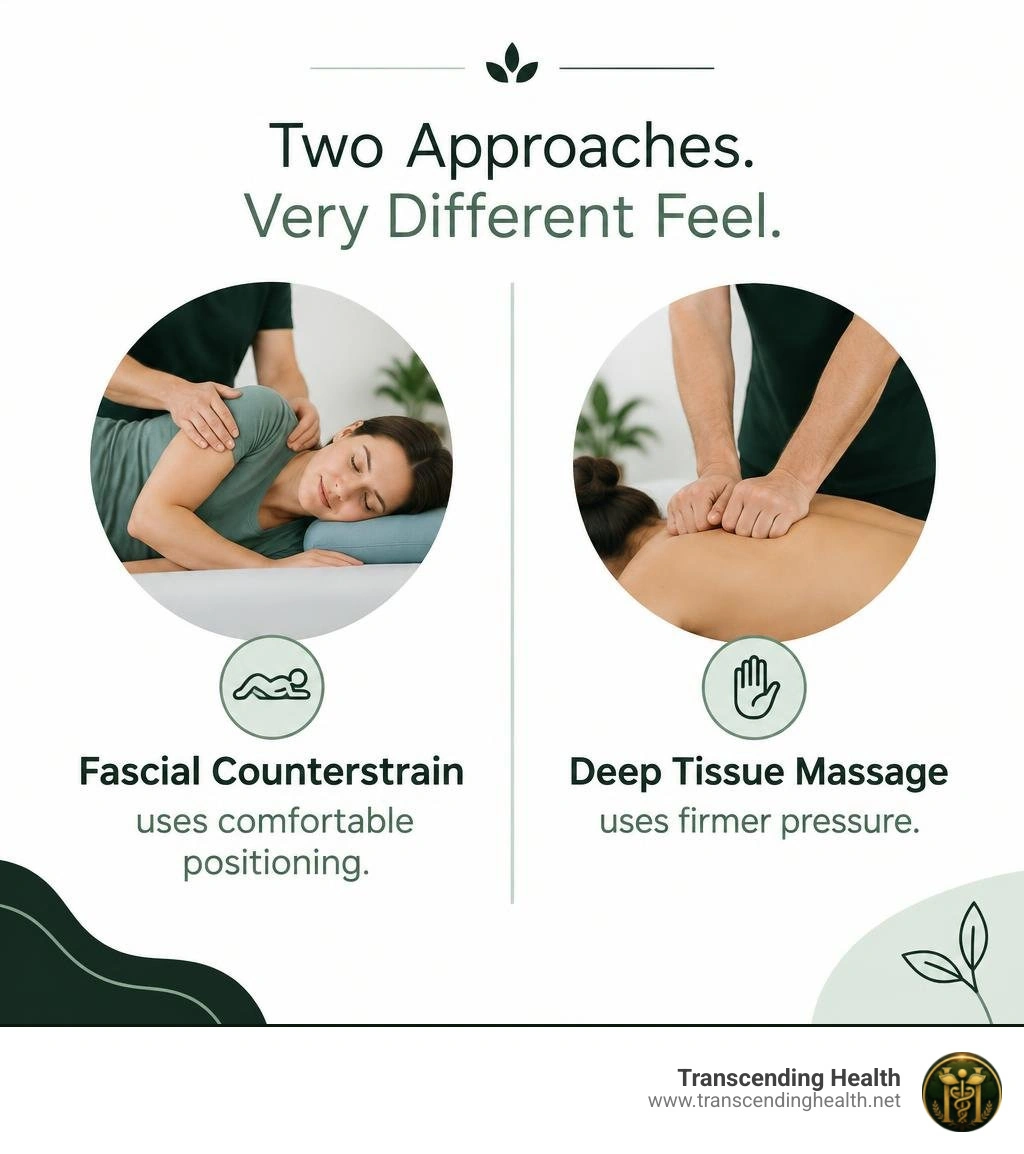
Fascial Counterstrain is a gentle, hands-on technique. It uses comfortable body positions to ease tender areas. It does not use firm pressure like deep tissue massage.
It may suit people with ongoing back, knee, or shoulder pain who find strong bodywork uncomfortable. It does not diagnose medical conditions, and results vary from person to person.
Key Takeaways
- Fascial Counterstrain uses gentle positions, not deep pressure.
- Each hold lasts about 40 to 90 seconds while you rest fully clothed.
- It aims to calm the body's protective "guarding" reflexes.
- Early research is promising but small, so we treat it as one part of a larger plan.
- At Transcending Health, sessions are with Yeda: $180 for 75 minutes.
At Transcending Health, Yeda offers Fascial Counterstrain as part of our personal approach to recovery. I'm Drew Edmondson, owner of Transcending Health. We blend hands-on care, recovery tools, and gentle movement for chronic pain and injury recovery.
Below, I'll explain how Fascial Counterstrain works. I'll also cover what you can expect during a session.
Some people try it alongside our massage therapy services. Others use it to manage long-lasting tension. Gentle positioning helps calm muscle guarding without setting off more tightening.
Many people in Charlottesville and Albemarle County find it a good starting point. It helps when deeper pressure has felt like too much. It also suits people who want bodywork that works with the nervous system, not against it.
How Is Fascial Counterstrain Thought to Work?
Fascial Counterstrain is an indirect manual therapy. That means the practitioner does not push into tight tissue. Instead, they gently place your body in a position of ease.
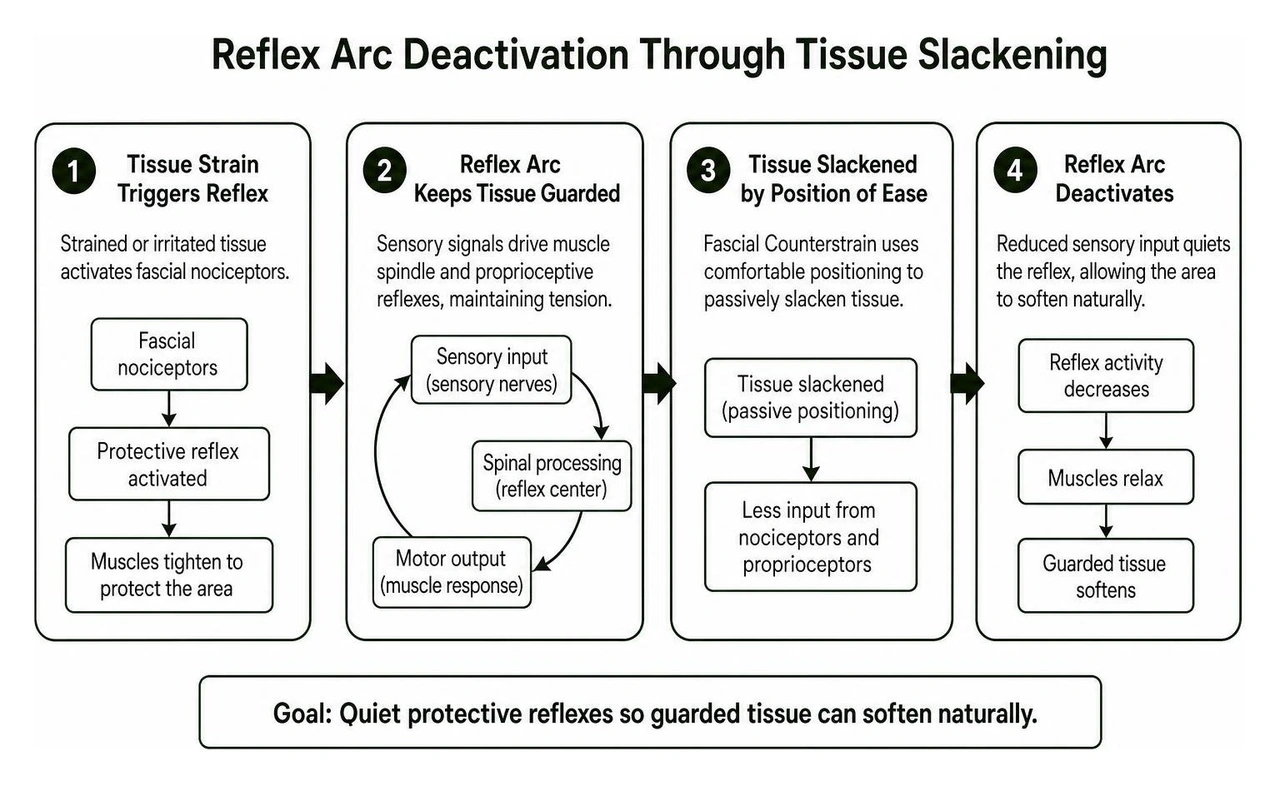
The goal is to calm protective reflexes. These are automatic signals between nerves and muscles that tell an area to tighten.
The Protective Reflex, Step by Step
- Tissue gets strained. Sensory nerve endings in the fascia notice the strain. (Fascia is the web of connective tissue that wraps muscles, nerves, and organs.)
- A reflex kicks in. These nerve endings send a protective signal, and nearby muscle and fascia tighten.
- The practitioner adds slack. Your body is moved into a comfortable position that takes the stretch off the tissue.
- The signal may quiet down. With less strain, the body's position sensors may stop calling for extra tension.
Research reviewed by the National Library of Medicine on counterstrain physiology suggests that indirect positioning may calm these sensors. It may also reduce muscle spasm without adding stress to the tissue.
How Did Fascial Counterstrain Develop?
- 1955: Dr. Lawrence Jones, an osteopathic physician, created classic Strain-Counterstrain. He found that placing a patient in a comfortable position relieved muscle spasm.
- Later: Physical therapist Brian Tuckey expanded this into modern Fascial Counterstrain. His model looks at tension in fascia around nerves, blood vessels, and organs, not just muscles.
Today, practitioners see the body as a connected web, not a set of separate muscles. Instead of chasing one sore spot, they may trace tension along related fascial lines. This helps explain why an area keeps tightening back up.
What Does the Interstitial Inflammatory Stasis Model Propose?
A key idea behind this method is Interstitial Inflammatory Stasis (IIS). In plain terms, it means fluid gets "stuck" in tissue that stays tight.
- When tissue stays in spasm, small blood vessels and lymph flow can slow down.
- Waste products from normal cell activity may then build up in the area.
- Gently taking pressure off the tissue aims to help fluid move again and support lymph flow.
The National Center for Complementary and Integrative Health notes that gentle hands-on methods are among the options people explore for chronic pain.
That is one reason people who didn't get lasting relief from firm bodywork sometimes try a gentler approach. They often use it alongside their current care.
What Does a Session Feel Like?

You stay fully clothed in loose clothing on a padded table. There is no heavy rubbing or forceful pressure. A typical sequence looks like this:
- The practitioner gently feels for tender points.
- They guide your body into a relaxed resting position.
- They hold that position for about 40 to 90 seconds.
- They slowly bring you back to neutral.
What Is the FCS Cranial Scan?
Many sessions start with an FCS Cranial Scan. The practitioner lightly feels the joints between the skull bones to check how easily tissue moves through the body.
This gentle check takes less than 60 seconds. It helps decide which fascial system to work on first.
How Is It Different from Deep Tissue Massage?
Deep tissue massage presses on muscles to lengthen them. Fascial Counterstrain does the opposite: it shortens and unloads the tissue.
| Feature | Fascial Counterstrain | Deep Tissue Massage |
|---|---|---|
| Applied Force | Gentle passive positioning; minimal pressure | Firm, localized mechanical pressure |
| Target Tissue | Multi-system fascial pathways | Skeletal muscle fibers and tendons |
| Client Sensation | Comfortable, passive slackening | Deep, often intense pressure |
| Nervous System Aim | Calms overactive protective guarding reflexes | Promotes mechanical release and blood flow |
Some people have a very reactive nervous system. For them, gentle slackening offers another way to ease long-term tension without soreness afterward.
That's one reason I often suggest it alongside our structural integration work. Structural integration also focuses on how fascia is organized.
Who Might Consider This Gentle Approach?

Because it avoids heavy pressure, people often consider it when they:
- Have ongoing tension that hasn't responded well to firm pressure.
- Feel flare-ups after deep tissue bodywork.
- Want whole-person care for conditions we treat with gentle hands-on methods.
- Want to combine bodywork with tools like SoftWave therapy for recovery support.
- Want a gentle hands-on option alongside focused cryotherapy or orthopedic laser therapy.
Some clients in Charlottesville and Albemarle County also pair it with personal training or corrective exercise. Calming muscle guarding can make it easier to do gentle movement work without pushing through pain.
How Might Gentle Hands-On Therapy Relate to Chronic Pain?
Widespread pain often comes with a more sensitive nervous system. Gentle methods stay within a pain-free range. This may help support the body's "rest and digest" mode.
A clinical review of fibromyalgia from the National Library of Medicine describes how the condition involves amplified pain signals. That is why gentle, non-threatening hands-on methods can feel more approachable.
What About Organs, Blood Vessels, and Nerves?
Fascia wraps around organs, nerves, and blood vessels. So practitioners may also look at tension in these areas:
- Visceral Fascia: Connective tissue around digestive or pelvic organs.
- Vascular Tunnels: Fascia around the veins and arteries near the spine.
- Nerve Sheaths: Easing tension around nerves in the arms and legs.
We explore these areas as part of a whole-person plan, not as a stand-alone fix. We often talk about breathwork and calming the nervous system too. A calmer nervous system tends to respond better to gentle positioning.
For clients who want to build on that calmer state, structural integration can help organize fascia across larger areas of the body.
What Does the Research Say?
Indirect hands-on therapies have been studied in clinical and osteopathic research. Studies note short-term drops in tender point sensitivity. They also note tissue that moves and gives more easily.
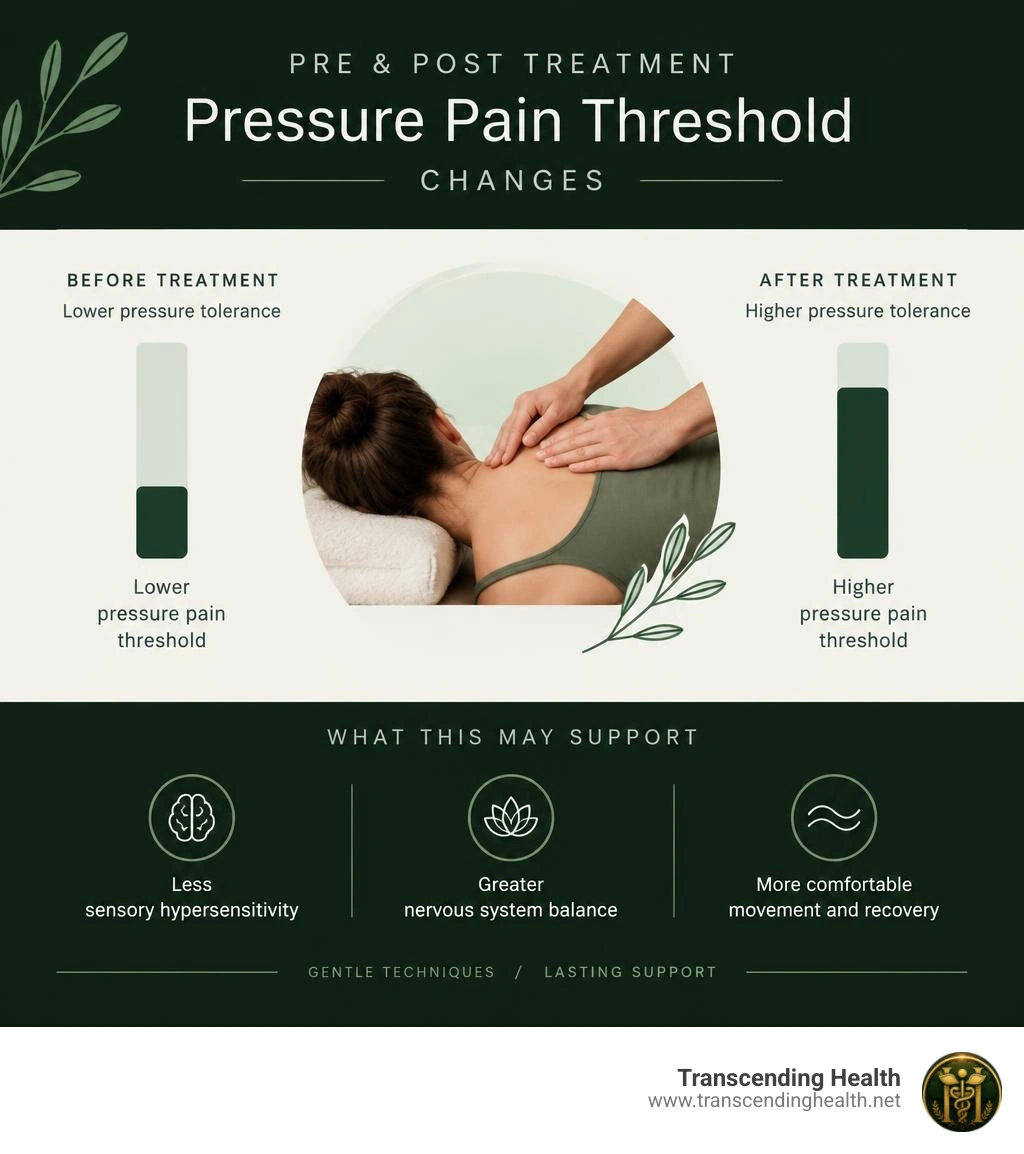
A case study in MDPI Medical Sciences used sensory testing. It recorded immediate changes after one indirect fascial decompression session.
What Changes Have Been Reported?
- Less pain build-up: The case study showed less "temporal summation," which is when repeated touch feels more and more painful.
- Higher pressure tolerance: The person could handle more pressure before it felt painful.
- Lab findings: In repetitive strain lab models, counterstrain positioning was linked to less interleukin-6, a protein tied to inflammation.
What Are the Research Limitations?
The research still has limits. Many studies look at one person or a small group. Larger, randomized controlled trials are still needed.
So we see Fascial Counterstrain as one option within a bigger recovery plan, not a guaranteed fix. We encourage clients to notice how their body responds over time.
That's also why we pair it with other tools. Some clients alternate it with massage therapy. Others combine it with movement coaching so a calmer body can turn into better day-to-day function.
Frequently Asked Questions
What is the FCS Cranial Scan, and does it diagnose medical conditions?
The cranial scan is a quick hands-on check of how tissue moves. Practitioners use it only to find areas of ease and plan the order of the bodywork. It is not an imaging tool, and it does not diagnose medical conditions.
How many sessions might someone consider?
Each person's nervous system responds in its own way, and the effects can build over time. So session pacing is set for each person. It depends on your comfort, your goals, and how your body responds.
Is the technique painful, or does it require deep pressure?
No. Fascial Counterstrain is designed to be fully comfortable. The practitioner moves your body into relaxed, slack positions. There is no forceful pressure or hard stretching.
How Can You Try Fascial Counterstrain in Charlottesville?
At Transcending Health, we believe better movement starts with listening to how your nervous system responds. Our center is in Charlottesville, Virginia.
We blend hands-on care, technology-based recovery tools, and gentle movement. The goal is to help you move with ease and build lasting strength.
Fascial Counterstrain is one piece of a bigger picture. We might also talk about massage therapy, SoftWave therapy, or focused cryotherapy. Every plan is shaped around your body and your goals.
- Practitioner: Yeda
- Session: 75 minutes for $180
- How to book: Use our appointment calendar to schedule a session.
Transcending Health
1445 Rio Road East, Suite 201 F
Charlottesville, VA 22901
Email: info@transcendinghealth.net