Exercises to Stop Slouching Shoulders at Your Desk
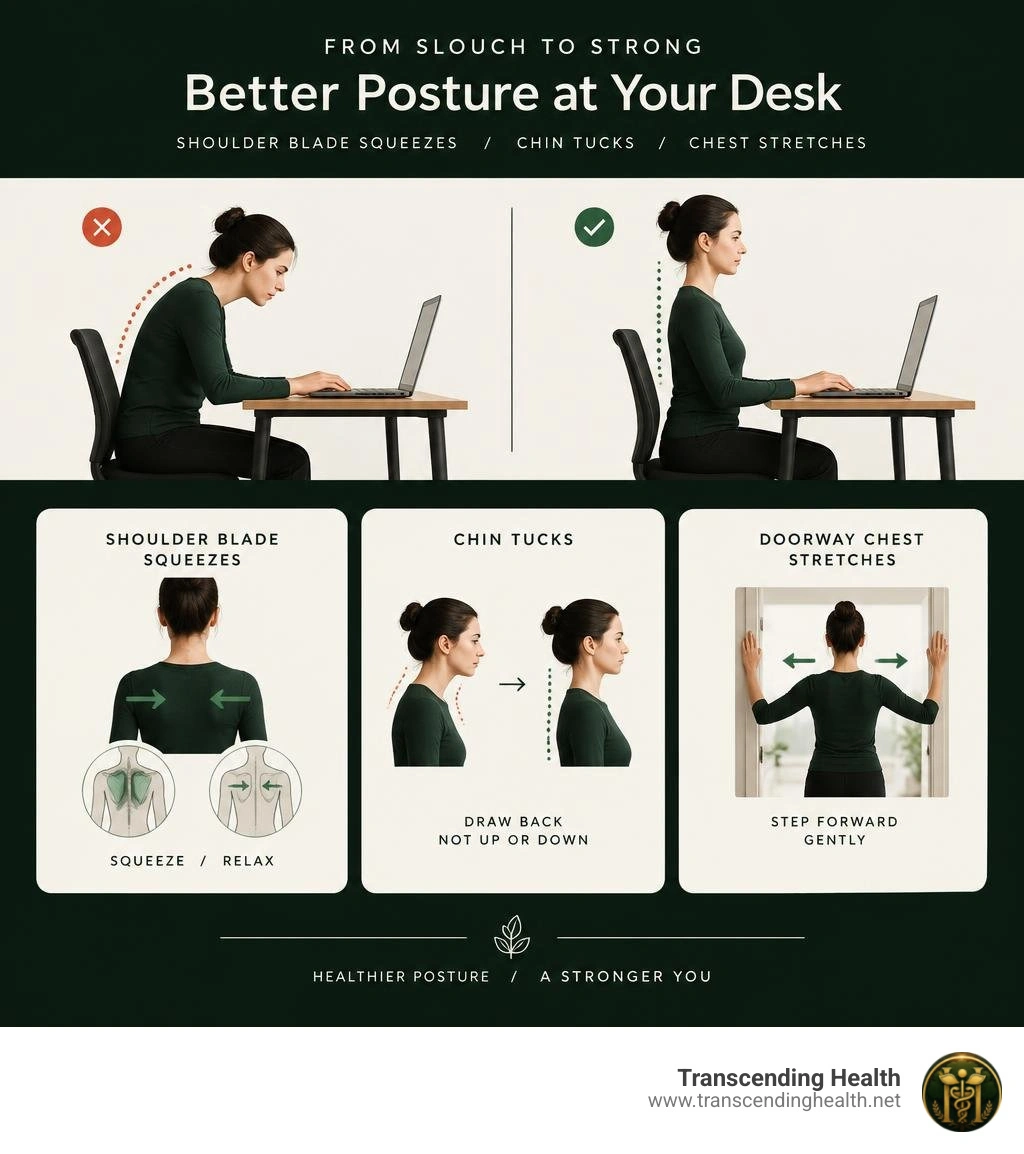
Practicing simple posture movements like seated shoulder blade squeezes, chin retractions, and doorway stretches can actively stop your shoulders from slouching forward during the workday. Performing these corrective drills resets muscular balance across your upper torso and neck.
Try these gentle exercises to stop slouching shoulders without leaving your desk area:
- Shoulder blade squeezes: Sit tall and gently draw your shoulder blades backward and down, hold briefly, and relax. Keep your neck loose and breathing steady.
- Chin tucks: Look straight ahead and glide your head smoothly straight back without tipping your chin up or down toward your chest.
- Doorway chest stretches: Place your forearms flat against a sturdy doorframe and step forward until you feel a gentle opening across your chest.
Extended hours of focused screen work naturally pull the body forward, making rounded posture feel like normal alignment over time. These corrective drills help you rebuild balanced alignment by reopening tight pectoral tissues and recruiting the mid-back stabilizers that support upright sitting. Always move with control, maintain steady breathing, and stop immediately if any movement creates pain.
I am Drew Edmondson, owner of Transcending Health in Charlottesville. Through personalized corrective exercise and guided mobility training, I help clients integrate reliable exercises to stop slouching shoulders into their everyday routines.
Why Do Your Shoulders Slouch Forward When Sitting?
When you sit working at a desk for consecutive hours, your body naturally seeks the path of least mechanical resistance. Over time, gravity pulls your head and rib cage downward and forward, gradually establishing a common muscular imbalance known clinically as Upper Crossed Syndrome.
In this forward-leaning posture pattern, the anterior chest structures, specifically the pectoralis major and pectoralis minor, become chronically shortened and hypertonic. At the exact same time, the posterior postural stabilizers along your spine, including the rhomboids, middle trapezius, and lower trapezius, become overly lengthened, inhibited, and weak. Because the shoulder blades, or scapulae, are floating structural bones connected to your rib cage primarily through dynamic muscular tissue rather than rigid bony joints, this persistent tension imbalance pulls both scapulae forward and upward into a sustained protracted state.
As explained in this desk worker guide for neck and back pain, chronic slouching creates repercussions extending well beyond simple shoulder posture. According to MedlinePlus guidelines on posture, sustained poor alignment misaligns the entire musculoskeletal system, accelerates joint wear along the cervical and thoracic spine, restricts optimal rib cage expansion during breathing, and frequently triggers chronic tension headaches and persistent neck stiffness during the working week.

What Are the Best Exercises to Stop Slouching Shoulders at Your Desk?

To counteract persistent workday slouching, you need a balanced routine combining active scapular retraction, deep cervical flexor recruitment, thoracic extension, and anterior chest mobility. You do not need specialized gym equipment or complex routines to reactivate dormant stabilizing muscles.
| Exercise | Target Muscles | Desk Focus | Recommended Volume |
|---|---|---|---|
| Seated Scapular Retractions | Rhomboids, Middle & Lower Trapezius | Upper back endurance & blade repositioning | 2–3 sets of 10–12 reps |
| Doorway Chest Stretch | Pectoralis Major & Minor, Anterior Deltoid | Opening anterior chest & shoulders | 3 sets of 20–30 sec holds |
| Seated Chin Tucks | Deep Cervical Flexors, Erector Spinae | Neutral head alignment & reducing neck strain | 2 sets of 10 reps (5-sec holds) |
| Wall Angels | Serratus Anterior, Lower Traps, Rotator Cuff | Dynamic scapular upward rotation | 2 sets of 8–10 slow reps |
Seated Scapular Retractions: Essential Exercises to Stop Slouching Shoulders
This isometric drill directly activates the rhomboids and mid-trapezius to draw your shoulder blades flat against the posterior rib cage. Movement recommendations from UW Orthopaedics and Sports Medicine emphasize targeted scapular retractions to re-establish joint stabilization and restore healthy shoulder mechanics after prolonged sitting.
- Sit tall at the front edge of your desk chair with feet planted flat on the floor.
- Rest your upper arms at your sides with both elbows bent comfortably to ninety degrees.
- Pull your elbows slightly backward while squeezing your shoulder blades together, imagining holding a small pencil between them.
- Ensure your upper neck muscles stay relaxed without letting your shoulders shrug upward toward your ears.
- Hold the muscular squeeze firmly for 3 to 5 seconds, then slowly release back to neutral.
Doorway Chest Stretches: Mobility Exercises to Stop Slouching Shoulders
Lengthening hypertonic tissue across the pectoralis minor allows your shoulder girdle to settle back into a neutral resting position. The Cleveland Clinic's posture exercise guidance highlights regular chest opening drills as a primary tool to counteract rounded desk posture and expand breathing capacity.
- Stand in an open doorway and place your forearms vertically against the frame with elbows bent around ninety degrees.
- Step one foot forward through the opening until you feel an even, comfortable stretch across your anterior chest and shoulders.
- Keep your rib cage stacked over your pelvis without overarching your lower lumbar spine.
- Take deep, slow breaths into your rib cage and hold the position for 20 to 30 seconds. Repeat two to three times.
Seated Chin Tucks and Cervical Retraction
When your shoulders slump forward, your head naturally migrates into forward head posture. Chin tucks strengthen the deep neck flexors while lengthening tight suboccipital muscles at the base of the skull.
- Sit upright with your shoulders relaxed, looking directly forward at eye level.
- Place two fingertips lightly against the center of your chin.
- Without tilting your head upward or nodding downward, draw your chin straight back as if making a subtle double chin.
- Hold the tucked position for 5 seconds, sensing the lengthening sensation through the back of your neck.
- Release smoothly and repeat for 10 controlled repetitions per set.
Desk Wall Angels and Thoracic Extension
Wall angels build endurance in the serratus anterior and lower trapezius while restoring thoracic mobility.
- Stand with your heels, glutes, upper back, and back of your head resting against a flat wall.
- Position your arms in a goalpost shape at ninety degrees, resting elbows and wrists against the wall surface.
- Slide your arms slowly upward overhead as far as possible without arching your low back away from the wall.
- Lower your arms smoothly back to ninety degrees, completing 8 to 10 controlled repetitions.
How Can You Rebuild Lasting Postural Alignment and Upper-Body Mobility?
While desk exercises provide immediate muscular relief and build posture awareness during the workday, resolving chronic shoulder slouching often requires a structured, full-body restorative approach. Years of repetitive seated habits create deep myofascial restrictions and compensatory movement patterns that independent stretching alone cannot always fully unwind.
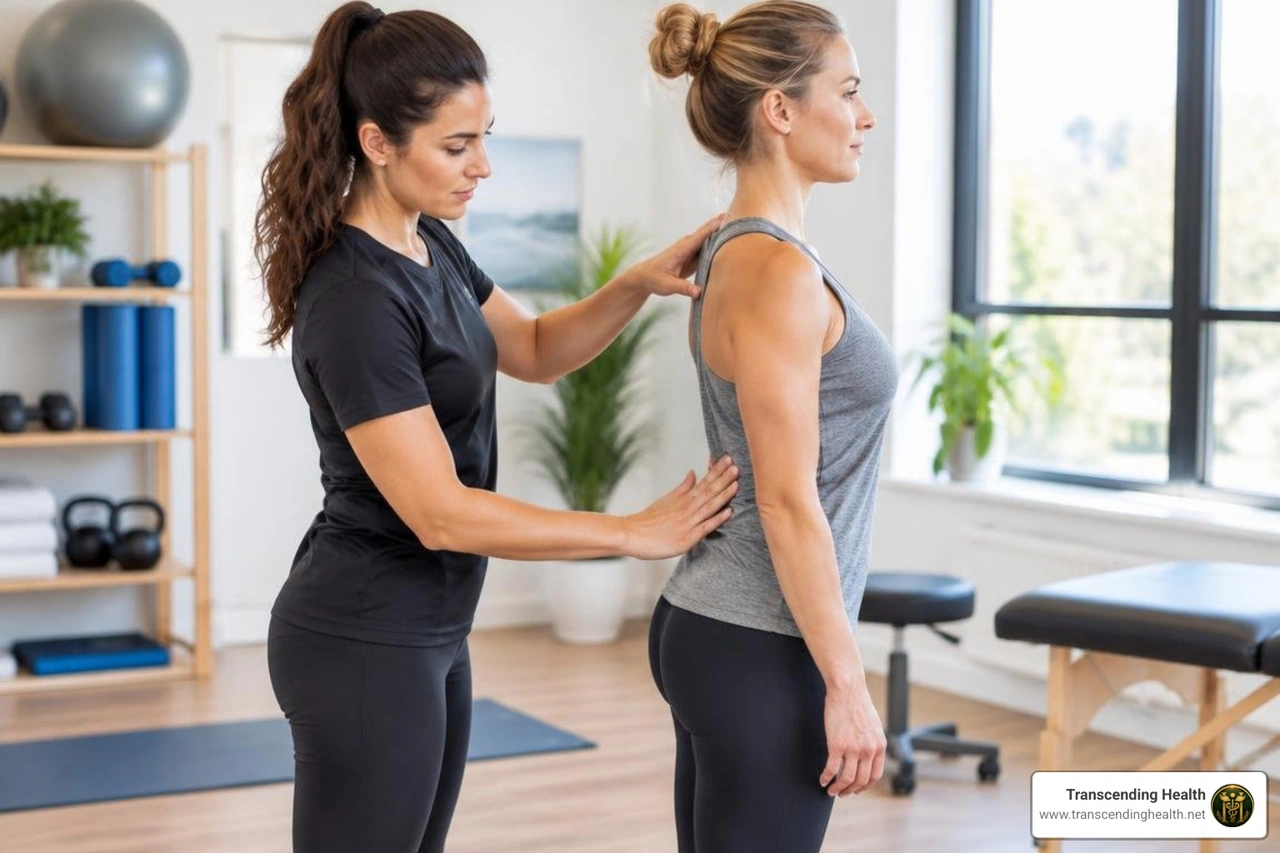
At Transcending Health in Charlottesville, we begin with a comprehensive new-client consultation and full-body postural assessment. We evaluate joint range of motion, scapular rhythm, spine mechanics, and soft tissue density. From there, we design an individualized restoration plan combining hands-on bodywork—including structural integration (Rolfing), fascial counterstrain, and medical massage—with targeted personal training and corrective exercise.
Pairing manual release of tight chest and shoulder fascia with progressive mobility training retrains your nervous system, restores balanced scapular stability, and makes comfortable upright posture your body's effortless natural state.
Frequently Asked Questions About Correcting Slouched Shoulders
Can rounded shoulders be corrected permanently?
Yes, rounded shoulders can typically be corrected permanently when addressed with consistent habit changes and targeted corrective exercises. In the overwhelming majority of desk workers, slouched shoulders represent functional soft tissue adaptations caused by repetitive daily habits and muscle imbalances rather than fixed structural changes in your bones. By routinely releasing tight anterior chest muscles, strengthening the postural stabilizers of the mid-back, and maintaining supportive desk ergonomics, your neuromuscular system gradually reorganizes so your shoulders rest naturally in balanced alignment.
How long does it take to see results from posture exercises?
Most individuals experience meaningful relief from neck, shoulder, and upper back tension within the first one to two weeks of performing consistent daily micro-breaks. Visible, lasting changes in resting posture typically develop within four to eight weeks of regular corrective movement, manual therapy, and progressive mobility work. This timeframe gives connective tissues time to remodel structurally while allowing your nervous system to cement new motor patterns into everyday muscle memory.
Are posture brace harnesses effective for rounded shoulders?
Passive posture braces are generally not recommended for lasting postural correction. Although a harness physically pulls your shoulders backward while you wear it, it acts as an external crutch that allows your postural muscles to disengage, which can weaken the mid-back and deep cervical stabilizers over time. Active corrective drills, ergonomic awareness, and targeted strength training deliver genuine, long-term results because they train your brain and muscular system to support your spine independently.
Ready to address chronic shoulder slouching and move with ease? You can schedule a consultation and postural evaluation at Transcending Health to create a personalized recovery and movement plan tailored to your body.