
Neck and Shoulder Self Massage You Can Do at Your Desk
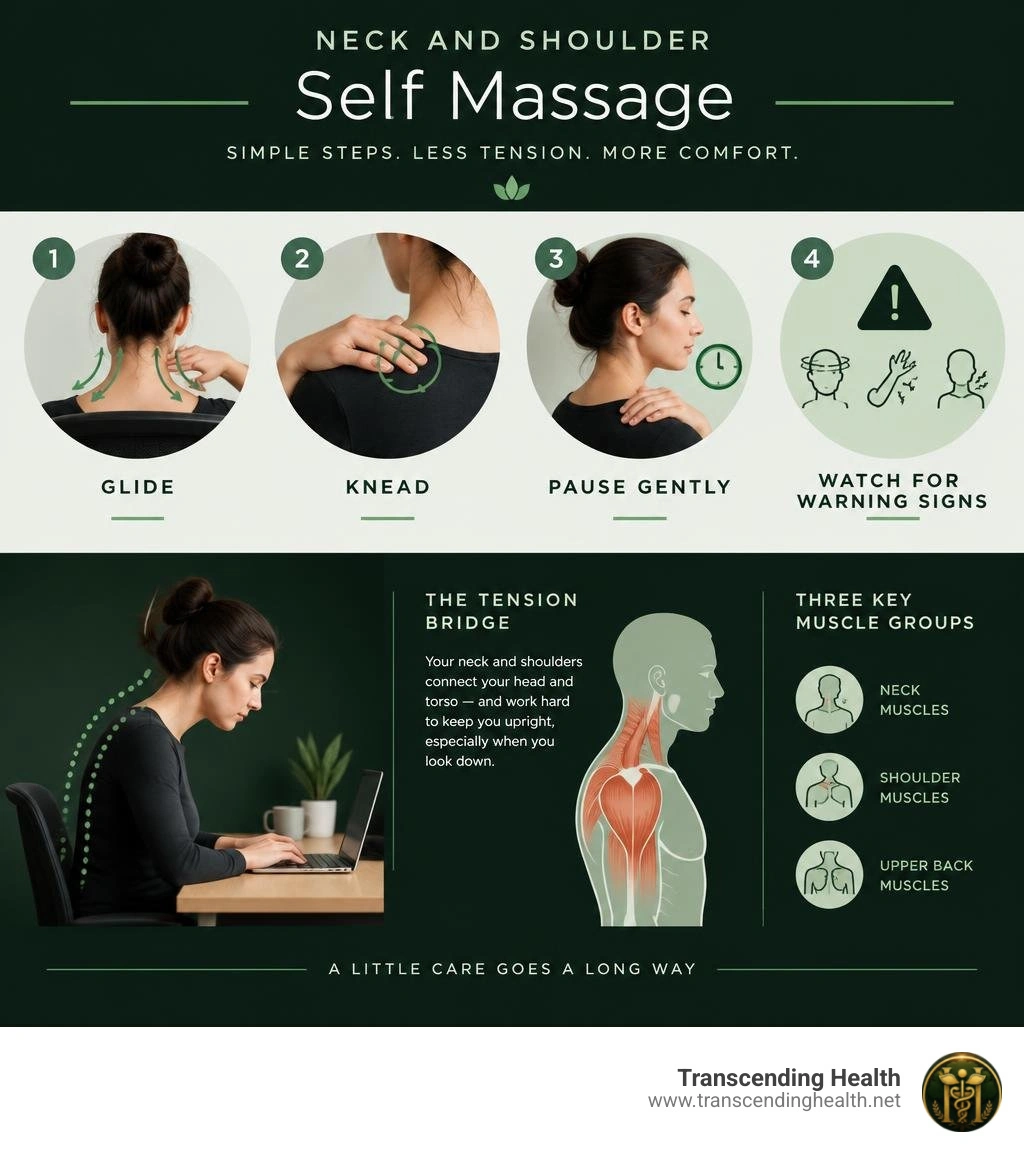
For neck and shoulder self massage, sit comfortably and let your shoulders drop. Glide your fingertips along the muscles at the back of your neck, gently knead the fleshy tops of your shoulders, then pause with light pressure on a tender spot while you breathe slowly. Avoid pressing on your spine or the front of your neck. Stop if you feel dizzy, numb, or have pain that travels down your arm.
I'm Drew Edmondson, owner of Transcending Health, a human restoration and performance center at 1445 Rio Road East, Suite 201 F, Charlottesville, VA 22901. My work brings together massage, corrective exercise, and whole-person recovery, and I'll show you where neck and shoulder self massage can fit into a simple care routine.
Why Do Neck and Shoulders Carry So Much Tension?
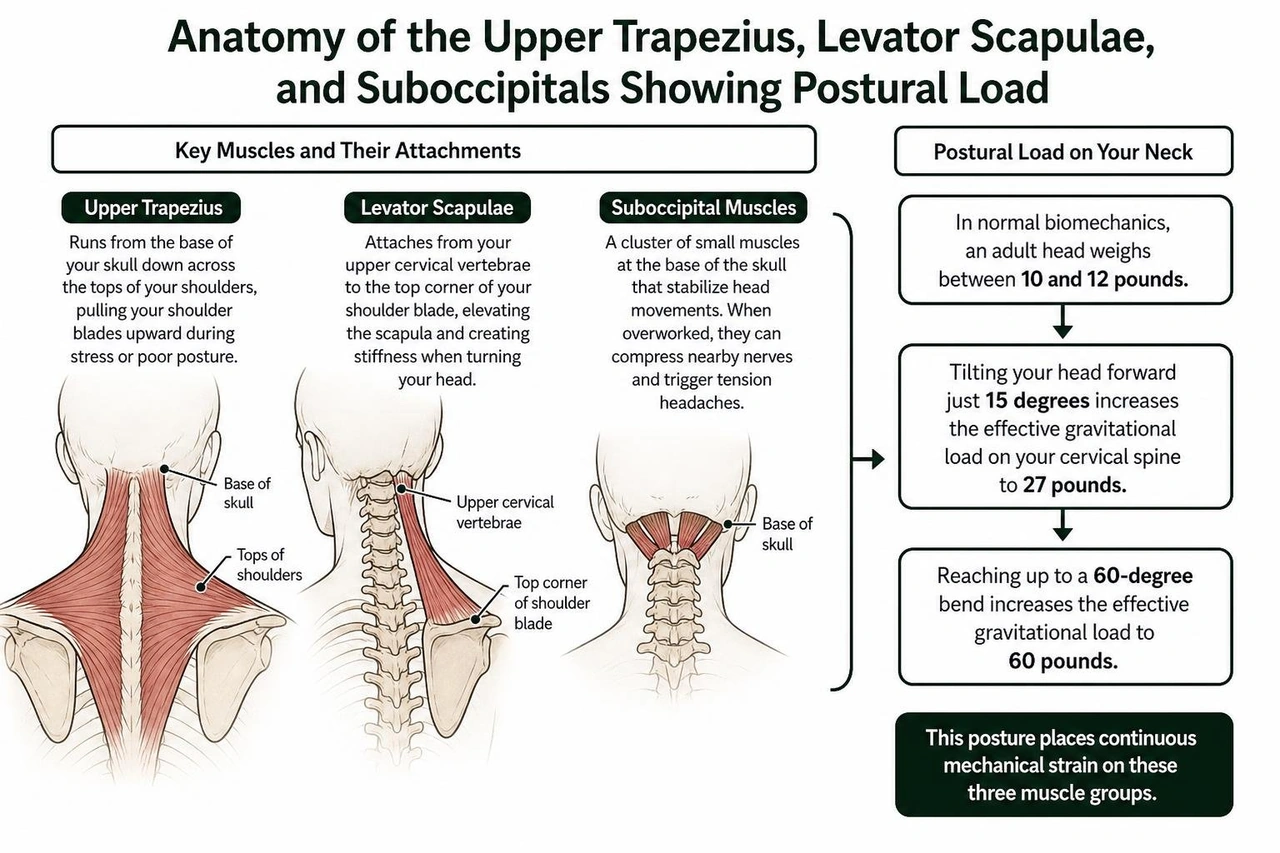
Your neck and shoulders act as the bridge between your head and your torso. When you look down at a laptop or check your phone, your upper back muscles must work constantly to keep your head upright. In normal biomechanics, an adult head weighs between 10 and 12 pounds. However, peer-reviewed spinal biomechanics research demonstrates that tilting your head forward just 15 degrees increases the effective gravitational load on your cervical spine to 27 pounds, reaching up to 60 pounds at a 60-degree bend.
This posture places continuous mechanical strain on three primary muscle groups:
- Upper Trapezius: Runs from the base of your skull down across the tops of your shoulders, pulling your shoulder blades upward during stress or poor posture.
- Levator Scapulae: Attaches from your upper cervical vertebrae to the top corner of your shoulder blade, elevating the scapula and creating stiffness when turning your head.
- Suboccipital Muscles: A cluster of small muscles at the base of the skull that stabilize head movements. When overworked, they can compress nearby nerves and trigger tension headaches.
When muscles stay contracted for hours, local blood circulation slows down and metabolic waste products build up. Over time, this leads to tender trigger points and restricted movement. To address the root issue, you must understand why muscle tension keeps returning instead of merely rubbing surface tissues when discomfort flares up.
Core Hands-On Techniques for Neck and Shoulder Self Massage

Performing self-massage by hand allows you to control the exact depth, rhythm, and placement of pressure based on what your body feels in the moment.
Essential Neck and Shoulder Self Massage Steps for Immediate Relief
Before digging into tender knots, you need to warm the superficial tissues and calm your nervous system.
- Effleurage (Warming Strokes): Place your flat palms or the pads of your fingers at the base of your skull. Gently glide your hands downward along both sides of your cervical spine toward your collarbones. Repeat these light sweeping strokes 6 to 8 times per side to bring fresh blood to the area.
- Petrissage (Kneading): Cross your right arm across your chest to reach your left upper trapezius. Cup the fleshy muscle between your thumb and fingertips. Gently squeeze, lift, and roll the tissue in a rhythmic motion. Work from the outside of the shoulder toward the base of the neck for 1 to 2 minutes, breathing deeply, then switch sides.
- Gentle Range-of-Motion Sweeps: While maintaining light contact with your shoulder muscles, slowly tilt your ear toward the opposite shoulder. This dynamic movement gently lengthens the muscle fibers while your fingers mobilize the tissue.
Sustained Compression and Trigger Point Decompression
Once the muscles are warm, locate specific tight bands or tender points along your upper trapezius or the top inside edge of your shoulder blade.
Apply sustained, direct pressure using two or three fingertips. Press firmly enough to feel a dull ache, but keep the intensity within a comfortable range—aiming for a 4 or 5 on a 10-point scale. Hold this static pressure for 20 to 30 seconds while exhaling slowly. As the muscle softens, you can slightly increase the pressure or make tiny circular motions before releasing.
For stubborn, deep-seated nodules that resist manual compression, specialized clinical modalities like trigger point massage therapy can help release deeply embedded fascial adhesions.
How to Use Simple Tools for Hard-to-Reach Upper Back Knots
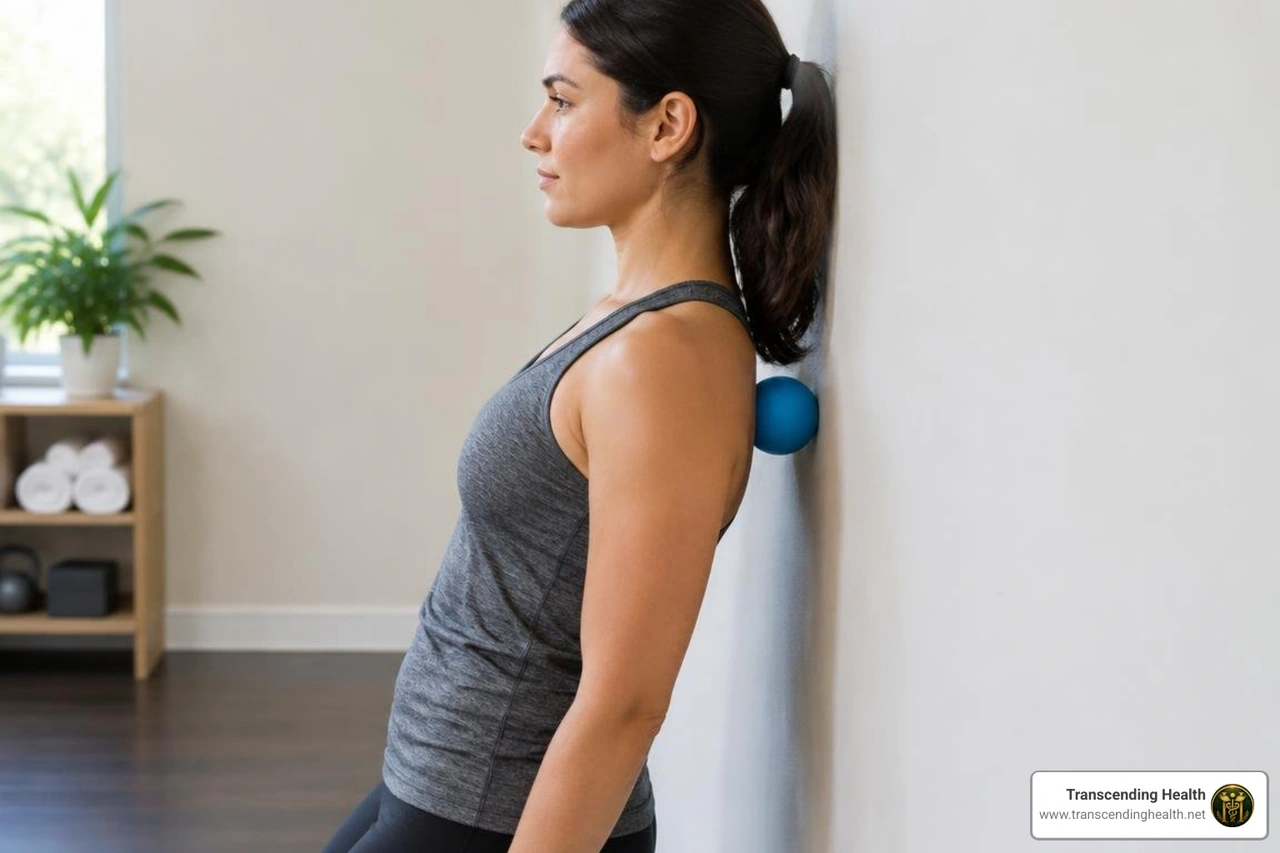
Your fingers can tire quickly when trying to reach between your shoulder blades. Using standard household tools, such as a tennis ball or lacrosse ball, lets you use your own body weight to apply steady pressure without straining your hands.
Targeted Ball Rolling for Rhomboids and Scapular Edges
The rhomboid muscles sit between your spine and your shoulder blade, often developing painful trigger points from rounded shoulders.
- Stand with your back against a smooth wall.
- Place a tennis or lacrosse ball between your spine and the inner border of your shoulder blade (never place the ball directly on the spinal bones).
- Cross your arms over your chest to draw the shoulder blades outward, exposing the rhomboid tissue.
- Bend your knees slightly to roll the ball up and down, or lean your body weight into a tender spot for 20 to 30 seconds.
- Slowly raise and lower your arm on that side to glide the muscle fibers beneath the ball.
Opening the Anterior Chest to Release Neck Tension
Chronic neck and shoulder tension is rarely just a back problem. When the pectoralis minor and major muscles across your chest become tight, they pull your shoulders forward, keeping your upper back in constant tension.
Place a massage ball against the front of your shoulder, just below the collarbone. Lean into a wall or doorway, applying gentle circular pressure across the chest muscle for 60 seconds per side. Releasing the anterior chest allows your shoulders to rest back naturally, taking mechanical strain off your neck.
Self-Care vs. Professional Bodywork: Knowing What Your Body Needs
Self-massage is a practical, cost-effective tool for daily maintenance. However, understanding its limitations helps you know when to seek clinical bodywork.
| Feature | Neck & Shoulder Self-Massage | Professional Clinical Bodywork |
|---|---|---|
| Primary Goal | Daily tension management & maintenance | Structural correction & root-cause resolution |
| Tissue Depth | Superficial to moderate layers | Deep fascia, joint capsules & postural chains |
| Assessment | Subjective, localized self-perception | Full-body functional & postural evaluation |
| Nervous System | Active self-application | Passive parasympathetic reset |
| Best Used For | Micro-breaks during work & light stiffness | Chronic pain, severe knots & restricted mobility |
According to data published by the American Massage Therapy Association, approximately 19% to 28% of American adults utilized massage therapy within a single twelve-month window to manage pain and improve mobility. Furthermore, a study in the Journal of Physical Therapy Science demonstrated that patients combining self-massage with corrective exercise experienced greater pain reduction during daily activities than those relying solely on standard passive modalities.
When chronic postural strain creates dense fascial restrictions, integrating your home routine with comprehensive professional massage therapy helps realign deep tissue layers and restore full range of motion.
Red Flags and When to Pause Neck and Shoulder Self Massage
Self-massage is generally safe, but you should stop immediately and consult a healthcare provider if you experience:
- Sharp, shooting pain or electrical sensations down your arm.
- Numbness, tingling, or weakness in your hands or fingers.
- Dizziness, lightheadedness, or visual changes during neck movements.
- Throbbing pain directly over the front or sides of the neck (near the carotid artery).
- Recent traumatic neck injury, unexplained swelling, or history of blood clots.
Daily Routines, Whole-Body Connections, and Partner Relief
Lasting relief requires consistency and an understanding of how your entire body connects. A tight pelvis or stiff thoracic spine alters how your rib cage sits, forcing the neck muscles to compensate.
The 5-Minute Daily Desk Reset
- Minute 1: Warm-Up: 6 gentle gliding strokes down each side of the neck.
- Minutes 2-3: Shoulder Knead: 60 seconds of petrissage kneading on each upper trapezius.
- Minute 4: Chest & Scapular Roll: 30 seconds of ball pressure on each chest wall.
- Minute 5: Postural Reset: Sit tall, perform 5 gentle chin tucks, and take 3 deep diaphragmatic breaths.
Partner-Assisted Relief
If a partner helps you, have them stand behind your chair and use the palms or flat knuckles to apply slow, downward pressure across the tops of your shoulders. Clear communication is essential—keep pressure comfortable, avoid pressing on the cervical spine, and maintain steady, relaxed breathing throughout.
Frequently Asked Questions About Neck and Shoulder Relief
How often can I perform self-massage on my neck and shoulders?
You can safely perform gentle self-massage 1 to 2 times daily for 3 to 5 minutes per session. Short, regular micro-breaks are much more effective at preventing postural strain than infrequent, aggressive sessions that leave tissues bruised.
Can aggressive self-massage make neck pain worse?
Yes. Pressing too hard on tight muscles can trigger protective muscle spasms, inflame sensitive nerves, and cause localized bruising. Always calibrate your pressure so it feels like a relieving ache rather than sharp discomfort.
Why does upper back and shoulder tension keep returning?
Tension often returns because the underlying structural causes remain unaddressed. If tight chest muscles, forward head posture, or poor hip alignment continue pulling your upper body out of balance, your neck muscles must work overtime to compensate.
Conclusion
Self-massage is a powerful daily habit for easing day-to-day tension, improving local blood flow, and keeping your neck mobile. But when knots persist or recurring pain restricts your movement, a comprehensive approach is the key to lasting recovery.
At Transcending Health in Charlottesville, we look at the whole picture. Our care model combines an initial body assessment with restorative hands-on therapy, corrective movement coaching, and advanced recovery technologies—including SoftWave acoustic wave therapy, focused cryotherapy, and orthopedic laser.
If you are ready to resolve stubborn tension and restore your natural mobility, book an appointment online or reach out to us at 434-465-2905 or info@transcendinghealth.net to get started.