

Can Massage for Neck Pain Really Help?
Massage for chronic neck pain eases muscular stiffness, lowers perceived pain intensity, and restores range of motion, particularly when paired with active movement strategies. When persistent cervical tension locks your neck into defensive guarding, manual therapy gently downregulates heightened nervous system signals and restores healthy tissue glide. Hands-on bodywork creates an immediate window of physical relief, though achieving long-term resolution requires addressing the underlying postural habits, muscular imbalances, and daily movement patterns that feed neck discomfort.
I am Drew Edmondson, owner of Transcending Health, a human restoration and performance center located at 1445 Rio Road East, Suite 201 F, Charlottesville, VA 22901. In our clinical work, we integrate specialized hands-on care, restorative modalities, and targeted corrective exercises to resolve stubborn cervical tension. If you are exploring therapeutic massage in Charlottesville, viewing bodywork as a foundational component within a comprehensive care plan provides the clearest path toward lasting comfort.

Chronic neck pain rarely occurs in isolation. Hours of sustained desk work, forward-head carriage, driving posture, and psychological stress place an immense physical burden on the cervical spine and surrounding muscular architecture. By applying targeted manual pressure to hypertonic muscles and restricted fascia, skilled bodywork helps release mechanical restrictions while restoring fluid mobility along the upper back and neck.
What Does Clinical Research Say About Massage for Chronic Neck Pain?
.webp "clinical manual therapy for neck strain")
Clinical trials consistently demonstrate that hands-on manual therapy delivers measurable reductions in neck stiffness and pain severity. A rigorous Cochrane systematic review on manual therapy for cervical discomfort evaluating 33 randomized controlled trials showed that therapeutic bodywork produces moderate, clinically meaningful short-term improvements in cervical pain intensity, daily function, and cervical spine range of motion.
The underlying physiological mechanisms behind these clinical outcomes are multifaceted. Deep, sustained manual compression stimulates local microcirculation and improves lymphatic drainage, clearing out metabolic waste products that accumulate in chronically contracted muscle fibers. Furthermore, specialized mechanoreceptor stimulation within fascial sheets signals the central nervous system to reduce resting muscle tone, breaking the self-perpetuating pain-spasm-pain cycle.
Comparing Manual Therapy with Self-Care Education and Standard Advice
Direct manual intervention consistently outperforms passive self-care materials and standard posture pamphlets. In a notable randomized trial on manual therapy for cervical spine symptoms, investigators evaluated participants receiving targeted hands-on bodywork against those given a comprehensive self-care education book. At 4 weeks, 35% of participants receiving hands-on bodywork improved by 5 or more points on the Neck Disability Index compared to only 7% using the self-care book (RR=5.1; 95% CI=1.2–21.3).
Additionally, 48% of the hands-on group achieved a 30% or greater drop in symptom bothersomeness, compared to 10% in the self-care book cohort (RR=4.7; 95% CI=1.5–14.5). Follow-up testing at 10 weeks demonstrated that 39% of bodywork participants maintained clinically significant disability improvements versus 14% of the book group (RR=2.7; 95% CI=0.99–7.5), proving that passive advice alone cannot match the structural impact of tactile therapy.
Key Clinical Outcome Measures: Interpreting NDI and Pain Severity Scales
To gauge real-world recovery, researchers utilize standardized, validated outcome measures:
- Neck Disability Index (NDI): A 10-section validated questionnaire evaluating how cervical symptoms limit daily activities, such as driving, reading, lifting objects, and sleeping soundly. A 5-point reduction indicates clinically meaningful functional improvement.
- Visual Analogue Scale (VAS) & Numeric Rating Scale (NRS): Calibrated 0-to-10 visual and numeric metrics measuring subjective pain levels. A 30% drop reflects significant clinical relief.
- Brief Pain Inventory (BPI): Evaluates overall pain intensity along with the degree to which discomfort interferes with focus, physical activity, emotional state, and quality of life.
What Are the Optimal Session Parameters and Techniques?
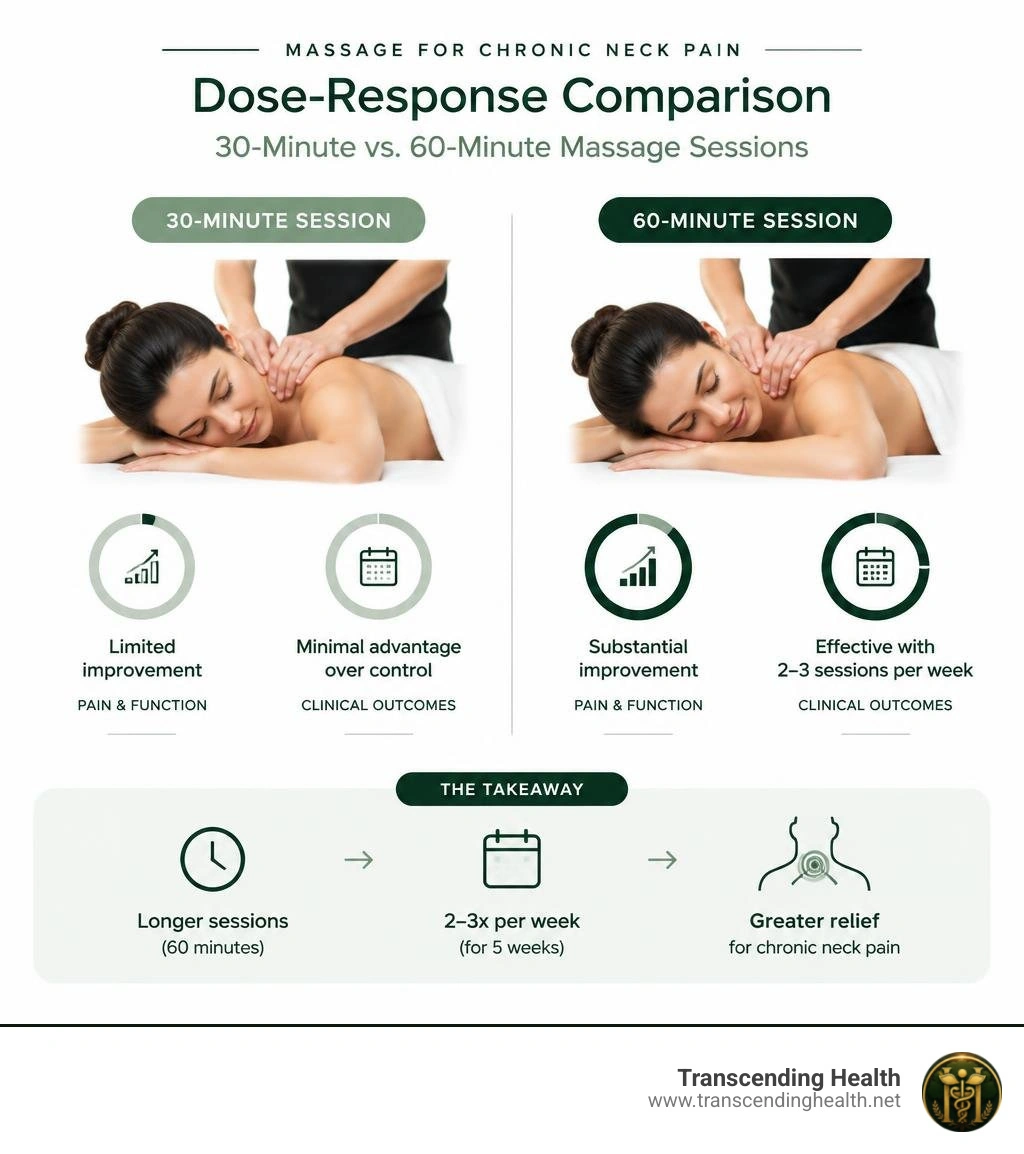
Achieving lasting relief from persistent neck tension depends significantly on treatment frequency and session duration. Brief, irregular visits rarely provide sufficient structural stimulus to reprogram chronic compensatory muscular patterns.
Determining the Effective Dose of Massage for Chronic Neck Pain
Clinical evidence indicates that therapeutic dosage directly dictates recovery outcomes. In structured dosing trials examining cervical discomfort, 60-minute treatment sessions delivered two to three times per week produced substantial, statistically significant improvements in functional mobility and comfort, whereas shorter 30-minute sessions showed limited clinical benefits over baseline controls.
Participants receiving full 60-minute treatments multiple times per week demonstrated marked reductions in daily disability and reported a substantial decline in their reliance on over-the-counter pain medications. Establishing an adequate frequency early in care allows restricted cervical tissues to adapt and reset before recurring daily stressors reintroduce defensive muscular tension.
Targeted Modalities: Deep Tissue, Myofascial Release, and Trigger Point Work
Different layers of the cervical musculature respond best to specialized hands-on techniques:
- Deep tissue bodywork: Targets the deep postural stabilizers of the spine, including the semispinalis capitis, splenius cervicis, and deep cervical paraspinals that carry continuous mechanical load.
- Myofascial release: Unwinds restrictions within the broad connective tissue network across the upper trapezius, levator scapulae, and anterior chest wall.
- Trigger point therapy: Deactivates hyperirritable, tender knots in muscle tissue that commonly refer radiating discomfort into the temples, base of the skull, and shoulder blades.
How Do Combined Interventions Improve Recovery and Mobility?
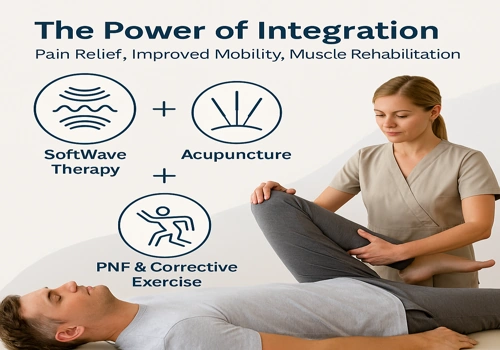
Hands-on therapy releases restricted tissues and creates a neuromuscular window of opportunity, while corrective exercise stabilizes those mobility gains for long-term health.

The landmark Stockholm Neck randomized controlled trial evaluated 619 participants and established that combining targeted manual bodywork with supervised exercise routines produced the fastest and most sustained recovery, with 55% achieving significant pain relief at 7 weeks (RR=1.39) and reporting superior recovery outcomes across all long-term evaluation checkpoints.
Integrating Exercise and Self-Administered Massage for Chronic Neck Pain
Active stability exercises reinforce passive tissue release. In a clinical cervical stabilization and self-applied techniques trial, researchers tested a 4-week program combining deep cervical flexor training (such as controlled chin tucks and towel nodding) with Thai self-massage using specialized wooden pressure tools.
Participants in the combined group reduced pain intensity from 4.96±1.33 to 1.65±1.43 on the VAS and lowered NDI scores from 9.26±2.97 down to 3.70±2.48, clearly outperforming passive stretching routines alone while achieving perfect protocol adherence without any adverse events.
Multi-Modal Care: Combining Bodywork with Advanced Recovery Tools
When stubborn cervical strain resists traditional manual therapy alone, layering innovative supportive tools helps accelerate deep tissue healing:
- Fascial Counterstrain: Utilizes gentle, passive positioning to release protective neural vasospasms surrounding cervical nerves and blood vessels.
- SoftWave (Acoustic Wave) Therapy: Employs electrohydraulic shockwaves to stimulate cellular repair, encourage local blood vessel formation, and calm chronic inflammation in stubborn connective tissues.
- Focused cryotherapy: Delivers pinpoint cold therapy directly to inflamed cervical facet joints and tender paraspinal muscles to soothe acute flare-ups.
- Orthopedic Laser Therapy: Delivers targeted light wavelengths into deeper cervical soft tissues to enhance mitochondrial ATP production and cellular repair.
Are Results Sustained Over Time, and What Are the Safety Considerations?
While manual therapy produces rapid symptom reduction, sustaining those benefits over months and years requires proactive lifestyle habits and consistent movement hygiene.
Long-Term Sustainability and the Role of Maintenance Care
Clinical studies indicate that without regular movement re-education and posture awareness, manual therapy benefits gradually taper between 12 and 26 weeks post-treatment. Daily ergonomic stress, computer work, and driving inevitably reintroduce mechanical strain. Periodic maintenance bodywork sessions help reset accumulating neuromuscular tension before minor tightness evolves into a debilitating pain flare-up.
Potential Adverse Effects and Clinical Screening Protocols
Therapeutic bodywork possesses an outstanding safety profile when delivered by experienced, licensed manual practitioners. Side effects are overwhelmingly mild and temporary, typically presenting as localized muscle soreness that resolves within 24 hours. A thorough initial assessment screens for contraindications, including progressive neurological deficits from severe disc herniations, vertebral artery insufficiency, severe osteoporosis, or acute inflammatory systemic conditions.
What to Expect From Massage for Neck Pain in Charlottesville
A thorough, professional manual therapy session begins well before hands touch tissue. A complete clinical assessment evaluates your neck mobility, spinal alignment, and postural compensations to identify the true root drivers of your neck strain.
During your initial consultation, your practitioner evaluates cervical active range of motion, scapular rhythm, thoracic spine extension, and breathing mechanics. Chronic forward-head posture frequently forces the suboccipital muscles and upper trapezius into constant overwork, while deep neck flexors and mid-back stabilizers become inhibited. Identifying these specific muscular relationships allows your therapist to build a customized treatment plan that addresses restricted structures while restoring natural balance to your upper body.
Which Type of Massage Is Best for Neck Pain?
There is no single best style. If you can point to one or two tender spots that send pain toward your head or shoulder blades, trigger point work is often a good fit; our guide to trigger point massage and muscle knots explains how it feels. If your neck feels broadly tight or pulling, read myofascial release vs deep tissue massage to compare slower fascial work with firmer deep tissue strokes. Many people do best with a blend, and your therapist can shift approaches during the session.
Massage for Neck Pain in Charlottesville: FAQs
How many sessions are typically needed to experience meaningful relief?
Most people notice measurable reductions in cervical pain and stiffness within 4 to 6 focused sessions scheduled over two to three weeks. Long-term tissue remodeling and muscular stabilization generally develop over a consistent 8-to-12-week comprehensive restoration plan.
Can therapeutic massage help desk workers with forward head posture?
Yes. Targeted bodywork releases chronically shortened anterior chest muscles, suboccipital tissues, and levator scapulae fibers while relieving strain across overstretched posterior neck muscles, making balanced upright posture significantly easier to maintain during desk work.
Is manual bodywork safe for persistent cervical tension?
When performed by a qualified, licensed practitioner who conducts a thorough initial intake to screen for vascular, bony, and neurological contraindications, therapeutic manual bodywork is exceptionally safe and gentle.
How much does massage for neck pain cost in Charlottesville?
At Transcending Health, a first-visit therapeutic massage with evaluation is $130 for 60 minutes, and a 60-minute deep tissue massage is $150. We do not bill insurance, but HSA cards and CareCredit are welcome.
Where can I get massage for neck pain in Charlottesville?
Our clinic is at 1445 Rio Road East, Suite 201 F, Charlottesville, VA 22901, with free parking. We are open Monday to Friday 9am to 7pm and weekends 9am to 6pm. Call 434-465-2905, or see our neck pain treatment in Charlottesville page.
When should I see a doctor before massage for neck pain?
Get checked first if neck pain follows a fall or accident, or comes with numbness, weakness, fever, a severe headache or pain that keeps getting worse. Massage does not diagnose or replace medical care.
Ready to address persistent tension and restore fluid, comfortable movement? Schedule your initial consultation with Transcending Health in Charlottesville today.