What Is Corrective Exercise?
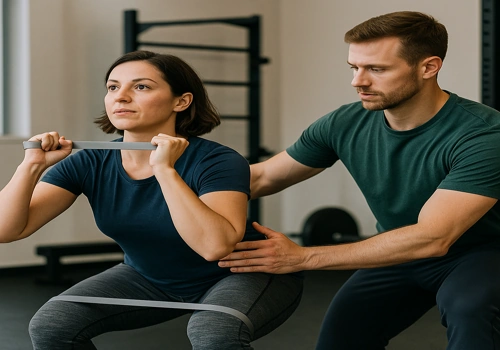
Corrective exercise uses a movement assessment and targeted exercises to help you move with better control. A practitioner may watch how you squat, step, or reach, then choose mobility, strength, and balance work based on what they observe. The goal is to make everyday movement and training feel more manageable, not to force your body into one “perfect” posture.
Movement patterns alone cannot explain or diagnose pain. If you have an injury, worsening pain, numbness, or tingling, seek guidance from a qualified healthcare professional.
I’m Drew Edmondson, owner of Transcending Health in Charlottesville. I’ve helped build coordinated recovery plans that include corrective exercise, movement coaching, and hands-on care for active adults working to move more comfortably. In our practice, we see people who want to bridge the gap between resting an irritated joint and returning to heavy training or daily outdoor recreation. By evaluating how joints move in sequence, we help you build physical resilience safely.
What Is Corrective Exercise and How Does It Work?
Corrective exercise applies principles of kinesiology and biomechanics to restore balance throughout your kinetic chain. The kinetic chain refers to the coordinated way your joints, muscles, and nervous system work together to produce motion. When one area experiences altered length-tension relationships or poor joint control, other segments naturally compensate to help you complete the task.
Our approach to personalized corrective exercise helps your nervous system re-learn efficient motor control. By fine-tuning how muscles fire together, we help distribute physical strain across the body rather than overloading a single joint. This means you can train harder, recover faster, and move with greater confidence without relying on inefficient compensatory habits that drain your energy.
How Does Corrective Exercise Differ from General Fitness Training?
General fitness programming focuses primarily on building cardiovascular capacity, muscle hypertrophy, or maximal strength. Corrective movement focuses on movement quality and joint control first. While traditional strength training aims to progressively load movement patterns with external resistance, corrective protocols refine the underlying neuromuscular sequencing before significant load is applied.
Fitness coaches working in a non-diagnostic setting use these techniques to optimize mechanics for active individuals. They do not diagnose injuries or manage medical pathology. If a client presents with sharp pain, swelling, or neurological symptoms, a professional movement coach recognizes the limits of their scope and refers them to an appropriate medical provider. Movement training complements medical care by re-educating movement once tissues are ready to handle functional demands.
Identifying Root Muscle Imbalances
When a muscle remains chronically shortened or hypertonic, it can inhibit its opposing muscle through a neurological process known as reciprocal inhibition. For example, sitting for long periods can cause hip flexors to remain tight, making it harder for the glutes to contract fully during standing activities.
Over time, synergist muscles step in to help, which leads to inefficient movement habits. Understanding the missing link between massage and movement helps explain why releasing tight tissues works best when paired with targeted strength drills that reinforce proper joint mechanics. By combining hands-on soft tissue release with active muscle re-education, we help neuromuscular pathways retain their newly gained functional range.
How Do You Assess Movement Dysfunctions?
A reliable movement strategy always starts with an assessment rather than guesswork. Movement professionals evaluate both static alignment and dynamic tasks to see how your body manages gravity and load. By observing your body during basic functional patterns, we can identify specific joint restrictions, poor muscle activation, and compensatory tendencies. This careful evaluation ensures your customized program accurately addresses your specific biomechanical needs.
What Do Postural Screens and the Overhead Squat Assessment Show?
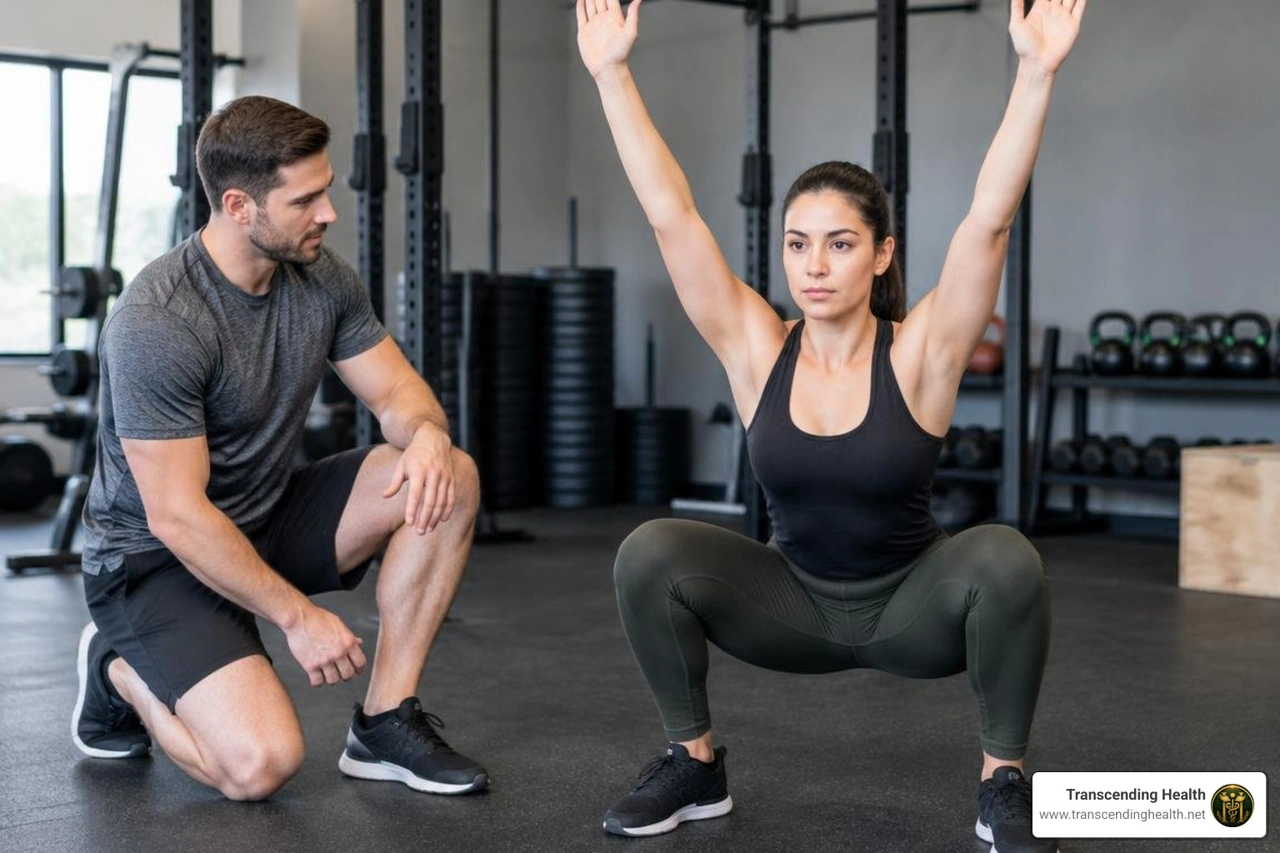
Dynamic screens, such as the Overhead Squat Assessment (OHSA), single-leg squats, and basic push-pull evaluations, provide real-time information about your kinetic chain. While an individual squats with arms raised overhead, a practitioner observes visual markers from the feet up to the shoulders. These screens reveal whether the knees collapse inward, the torso leans excessively forward, or the lower back rounds under movement. These visual cues highlight where muscles may be overactive or lengthened across multiple planes.
What Are Common Kinetic Chain Compensations?
Common compensation patterns include:
- Knee Valgus: Inward collapse of the knees during squatting or landing, often linked to restricted ankle dorsiflexion or weak hip stabilizers.
- Anterior Pelvic Tilt: Forward tipping of the pelvis accompanied by an excessive arch in the lower back, often involving tight hip flexors and underactive abdominals.
- Pronation Distortion Syndrome: Excessive foot flattening paired with internal rotation of the lower leg and thigh, stressing the ankles, knees, and hips.
- Upper Crossed Syndrome: Forward head posture and rounded shoulders from tight chest musculature and lengthened upper back stabilizers.
Addressing these compensations through targeted mobility training restores healthy range of motion and joint positioning, helping protect your kinetic chain during both daily living and demanding athletic activities.
How Can a Corrective Exercise Continuum Guide Program Design?
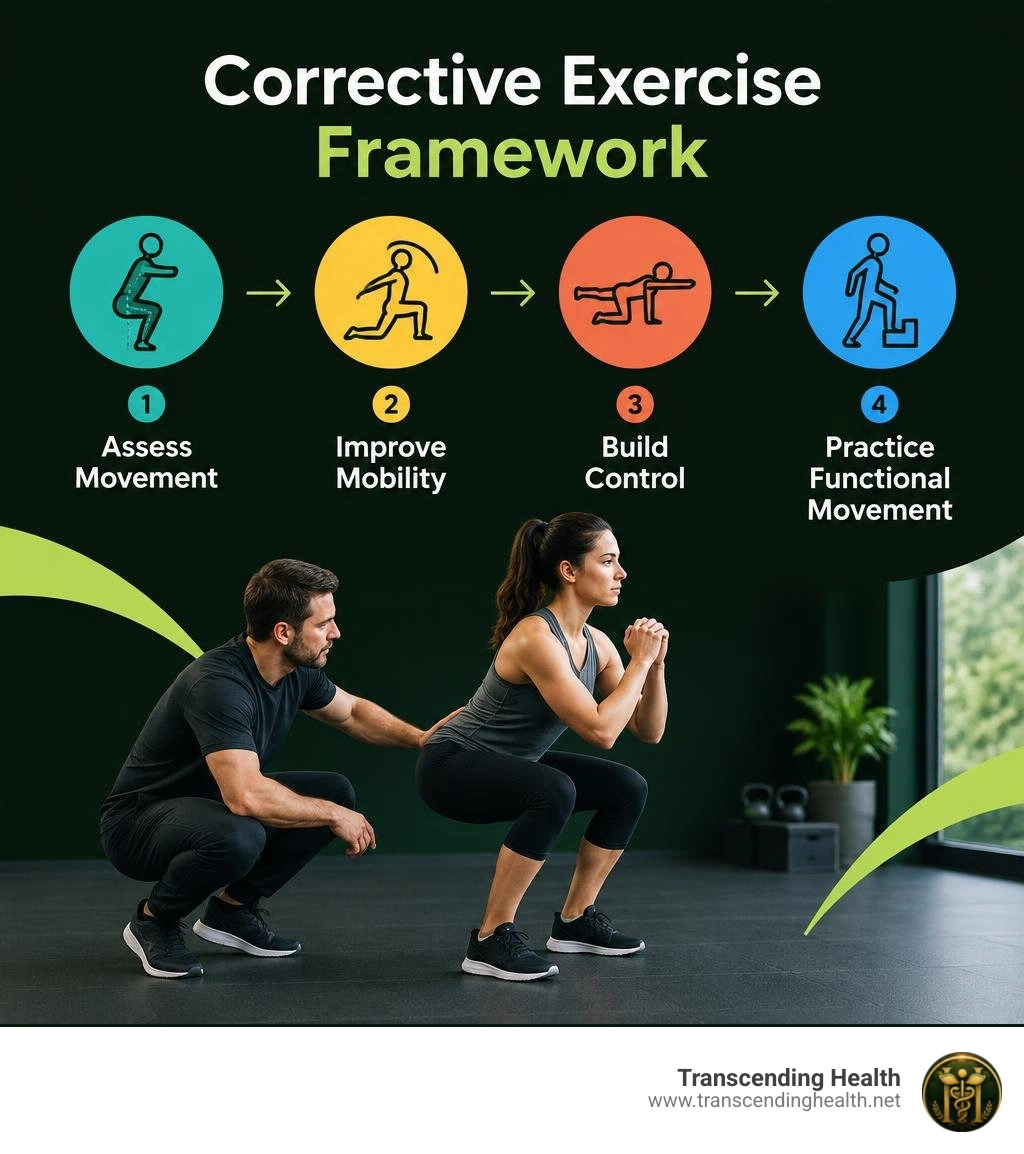
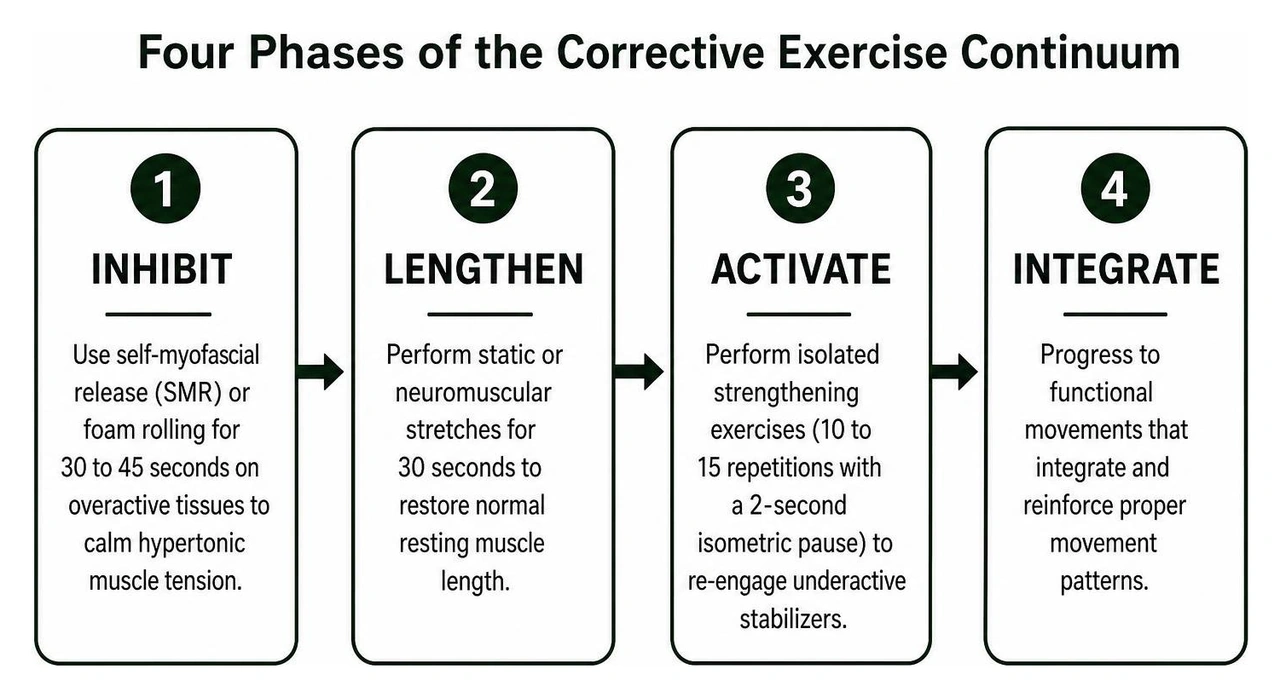
To address movement compensations systematically, practitioners frequently use structured frameworks such as the NASM Corrective Exercise Continuum working guide. This four-step sequence organizes exercises to create lasting neuromuscular changes. By moving methodically through each phase, you calm overactive muscle groups, lengthen restricted tissues, re-awaken dormant stabilizers, and integrate full-body coordination into daily activity.
What Are the Phases of Corrective Exercise Programming?
- Inhibit: Use self-myofascial release (SMR) or foam rolling for 30 to 45 seconds on overactive tissues to calm hypertonic muscle tension.
- Lengthen: Perform static or neuromuscular stretches for 30 seconds to restore normal resting muscle length.
- Activate: Perform isolated strengthening exercises (10 to 15 repetitions with a 2-second isometric pause) to re-engage underactive stabilizers.
- Integrate: Practice dynamic, multi-joint exercises (such as step-ups or squat-to-rows) to train muscles to fire in functional patterns.

How Can You Apply Corrective Exercise Safely?
A corrective sequence works best when placed directly within an 8- to 12-minute warm-up before standard strength workouts. Movement patterns should be reassessed every 4 to 6 weeks to adjust exercise selection. If any movement triggers pain, dizziness, or sharp discomfort, the exercise should be modified or stopped immediately. This structured progression ensures your tissues adapt gradually to functional loading without excessive physical strain. Consistency is essential when retraining motor patterns, as the nervous system requires repeated clean repetitions to establish new movement baselines.
What Does the Scientific Evidence Say About Corrective Movement?
Clinical research demonstrates that systematic exercise progressions provide measurable benefits for balance and stability across diverse populations. In a systematic clinical trial on pronation distortion syndrome, researchers evaluated the effects of a 12-week corrective exercise program on lower-limb mechanics and balance.
The trial revealed that participants in the corrective exercise group significantly improved static balance on the Flamingo balance test (improving to 42.26 ± 5.35 seconds compared to 10.13 ± 1.92 seconds in the control group) and dynamic balance on the Star Excursion Balance Test anterior reach (reaching 82.4 ± 6.2 cm compared to 66.7 ± 6.9 cm in controls). Stabilometry testing also confirmed substantial reductions in dynamic postural sway, showing that retraining proximal hip stabilizers directly improves distal lower-leg stability.
These clinical findings confirm that targeted exercise progressions do not simply alter local muscle tone; they actively reorganize central sensorimotor control. When kinetic chain segments work harmoniously, physical stress is distributed efficiently across joints, helping reduce fatigue during prolonged weight-bearing activities.
What Are the Common Myths About Posture and Movement Correction?
A common myth is that there is a single “perfect” posture that everyone must hold at all times. In reality, healthy bodies naturally tolerate a variety of positions, and your best posture is often your next posture. Research on quiet standing shows that maintaining upright posture requires only a small fraction of maximal muscle activation, which means minor structural asymmetries are normal and rarely indicate tissue damage.
Furthermore, spine imaging studies reviewed by the Mayo Clinic on back pain and other research centers note that disc degeneration and structural changes are widespread in healthy, pain-free adults as a normal part of aging. Telling people their bodies are “broken” or “misaligned” can create unnecessary fear (a nocebo effect) that discourages helpful physical activity.
Movement quality is ultimately about expanding functional movement options, building tissue tolerance, and promoting healthy circulation—not chasing unattainable structural perfection. Corrective drills serve as valuable tools for restoring movement comfort and neuromuscular coordination, rather than rigid formulas meant to force joints into imaginary ideal positions.
Frequently Asked Questions About Movement Optimization
Can targeted movement protocols relieve chronic back stiffness?
Yes. Prolonged sitting can reduce local tissue circulation and create feelings of tightness. Incorporating regular movement breaks alongside gentle spinal mobility and core activation exercises helps restore intra-neural blood flow and eases stiffness. Simple daily movements encourage tissue hydration and keep spinal joints moving smoothly.
How can you track mobility improvements?
You can track mobility by taking regular movement assessments every 4 to 6 weeks, checking joint range of motion, and noting improvements in control during dynamic exercises like squats and lunges. Keeping a simple training log helps you observe how comfortably your body handles daily physical tasks over time.
What career benefits can come with a specialist credential?
Fitness professionals who complete advanced specializations expand their assessment skill set, improve client retention, and better serve post-rehab populations. Surveys by the National Academy of Sports Medicine show that trainers holding a corrective exercise credential report earning an average of 26% more than their non-credentialed peers. This training also allows coaches to communicate more effectively with allied healthcare providers.
How Can You Support Resilient Movement in Charlottesville?
At Transcending Health in Charlottesville, we believe lasting physical resilience comes from combining intelligent movement with restorative recovery care. Whether you are addressing nagging movement restrictions, recovering from an active season, or building functional strength, our integrative team provides personalized movement coaching, manual therapies, and advanced modalities like SoftWave acoustic wave therapy and focused cryotherapy.
Our customized approach begins with a comprehensive body assessment to identify your specific movement patterns and restrictions, followed by an individualized recovery roadmap that fits your lifestyle. Ready to understand how your body moves and build a foundation for comfortable, confident activity? You can schedule your body assessment with our team today.