A typical overload story
Pain often shows up after you add running days, distance, speed, hills, court time or jumping. It may spread along a wide part of the inner shin. It often eases when you cut back on impact.

Go beyond rest and wait. Get a clear plan to check your shin pain, adjust your training, build lower-leg strength, and ease back into running.
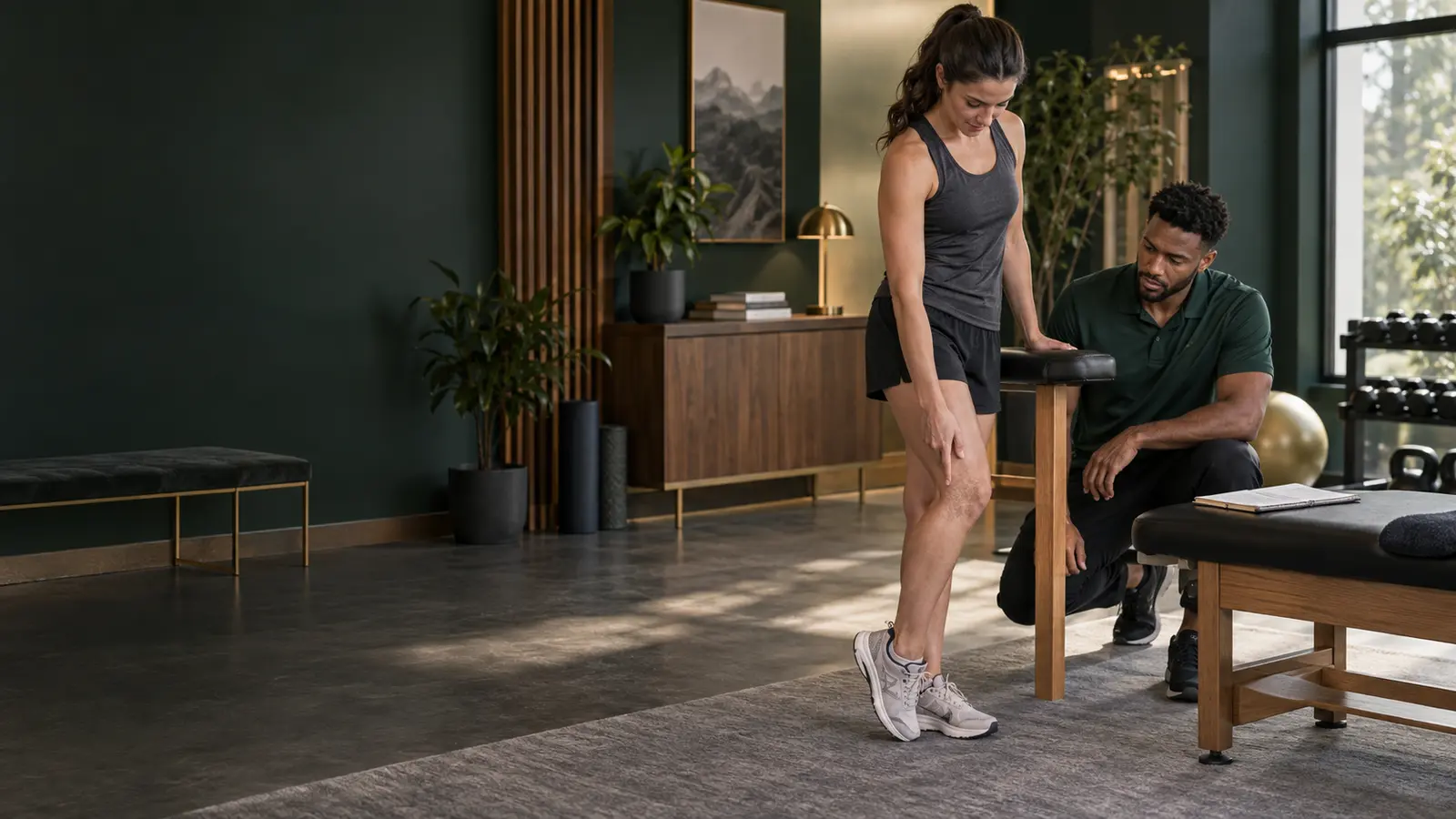
“Shin splints” most often means pain along the inner edge of the shinbone that comes on with exercise. Doctors may call it medial tibial stress syndrome. Shin splints recovery at Transcending Health helps runners and active people get back to their sport. We are at 1445 Rio Road East in Charlottesville, VA. Recovery often starts by cutting back the impact that sets off pain. Next, we check for problems that need a doctor. Then we slowly rebuild the calf, foot, hip and your running. Where you start depends on your pain—not on one set rest period for everyone.
Shin pain is a sign, not a diagnosis. A good first step is to ask: does this look like slow overuse? Or does it need a doctor to check for a bone stress injury, compartment syndrome, a tendon or nerve problem, or something else?
Pain often shows up after you add running days, distance, speed, hills, court time or jumping. It may spread along a wide part of the inner shin. It often eases when you cut back on impact.
See a doctor before more impact training if you have pain in one small spot, pain when you walk, a limp, or swelling. The same goes for pain at rest or at night, pain that gets worse fast, or pain after a hit.
Get urgent care if you have bad swelling or can’t put weight on the leg. Also go if the leg looks out of shape, numbness or weakness is getting worse, the leg is red and hot with a fever, or the pain seems far too strong.
The shin reacts to how much you ask of it versus how much it can handle right now. One cause rarely tells the whole story.
Adding miles, speed, hills, hard ground or extra days all at once can load the lower leg faster than the body can adjust.
Your calf stamina, foot and ankle control, hip strength, balance and impact tolerance may lag behind the running you want to do.
Sleep, food, stress, past injury, hard physical work and back-to-back hard workouts all change how much training you can handle.
Runners in Charlottesville and Albemarle County mix pavement, hills, sloped roads, tracks and rough trails. Miles alone don’t tell you how hard that is.
Worn shoes or a sudden switch can matter. But no shoe can make up for every training mistake. A slow change to new shoes tells you more than hunting for one “best” shoe.
If you keep not getting better, it is time to look again. Don’t stay stuck in a loop of foam rolling, stretching and pushing through the same pain.
The goal is to find a start point you can handle. Then we rebuild what your sport needs. We move ahead based on how you feel during the session, the next day and in daily life.
For now, cut back the running, jumping or hills that make pain flare. Keep up easy daily movement. Do low-impact fitness work if it is safe and you are cleared.
Build calf and soleus strength, foot and ankle control, balance and hip strength. Help the lower leg handle more repeated load.
Start with an easy walk-run or a small dose of your sport. Change time, speed, hills, surface and how often one at a time. That way you can tell what your body reacts to.
Work up to your real goal—road running, trail miles, court or field sports, dance or fitness. Keep up your strength and recovery habits as you go.
We choose care based on where you are in recovery. When needed, we work around advice from your doctor or physical therapist. Hands-on care may help you feel better. But strength and load tolerance come back through activity that builds step by step.
Build calf, foot, ankle and hip strength, balance and fitness. We scale each exercise to how your shin feels now.
Once a doctor has ruled out bone or blood vessel problems, focused bodywork may ease tight muscles and help you move more easily. It does not heal a stress fracture or take the place of strength work.
Bring together movement coaching, recovery habits and support services. We plan them around your training, your work and your return to sport.
Local terrain can show a gap. You may feel fine on flat ground but not on hills, downhills, rough trails or long paved routes. A return plan can start on a steady, even surface. Then it adds distance, speed, slope and rough ground one at a time.
For the big picture, see Transcending Health’s Recovery & Performance pathway. It links recovery with the strength and fitness you need to perform again.
These sources back up what this page says about shin splints, overuse, other causes of shin pain and a slow return. They do not replace an exam of your own leg.
Covers inner shin pain, the training changes that often cause it, other causes of shin pain, and why a slow return to exercise matters.
Covers overuse injuries, fast jumps in training, hard ground, good gear and warning signs that need a doctor.
Looks at how the problem shows up, how load affects bone, risk factors, why diagnosis can be hard, and the weak proof for any one treatment for all.
Shin splints is a common name for exercise-related pain along the inner edge of the tibia, often described clinically as medial tibial stress syndrome. The term should not be used to label every kind of lower-leg pain.
You cannot reliably diagnose the difference at home. Pain concentrated in one small spot, pain with ordinary walking, limping, swelling, rest or night pain, or symptoms that keep worsening are reasons to stop impact activity and seek medical evaluation.
Do not keep repeating a dose that causes escalating pain or declining function. Some people can maintain medically appropriate low-impact conditioning while running is reduced, then return through a gradual walk-run progression.
Massage may help surrounding muscle tension and short-term comfort after concerning causes of shin pain have been excluded. It does not diagnose the problem, heal a bone-stress injury, or replace progressive strengthening and load management.
A plan may include straight-knee and bent-knee calf raises, foot and ankle control, balance, hip strengthening, walking or running drills, and progressive impact work. Selection and dosage should match the current pain response and activity goal.
There is no single reliable timeline. Recovery varies with symptom severity, how long the problem has been present, whether another diagnosis is involved, current strength and conditioning, and how progressively impact is reintroduced.
Meet with Transcending Health at 1445 Rio Road East, Suite 201 F, Charlottesville, VA 22901. We’ll help you see your next step. We’ll work around your doctor’s advice. And we’ll map the path from recovery back to performance.