Painful First Steps
Stiffness in the morning or after sitting may ease as you move. Then it may come back after a hard day.
A careful plan for painful first steps, tendon pain from running and weak push-off. It starts with screening, then builds load step by step to fit your life.
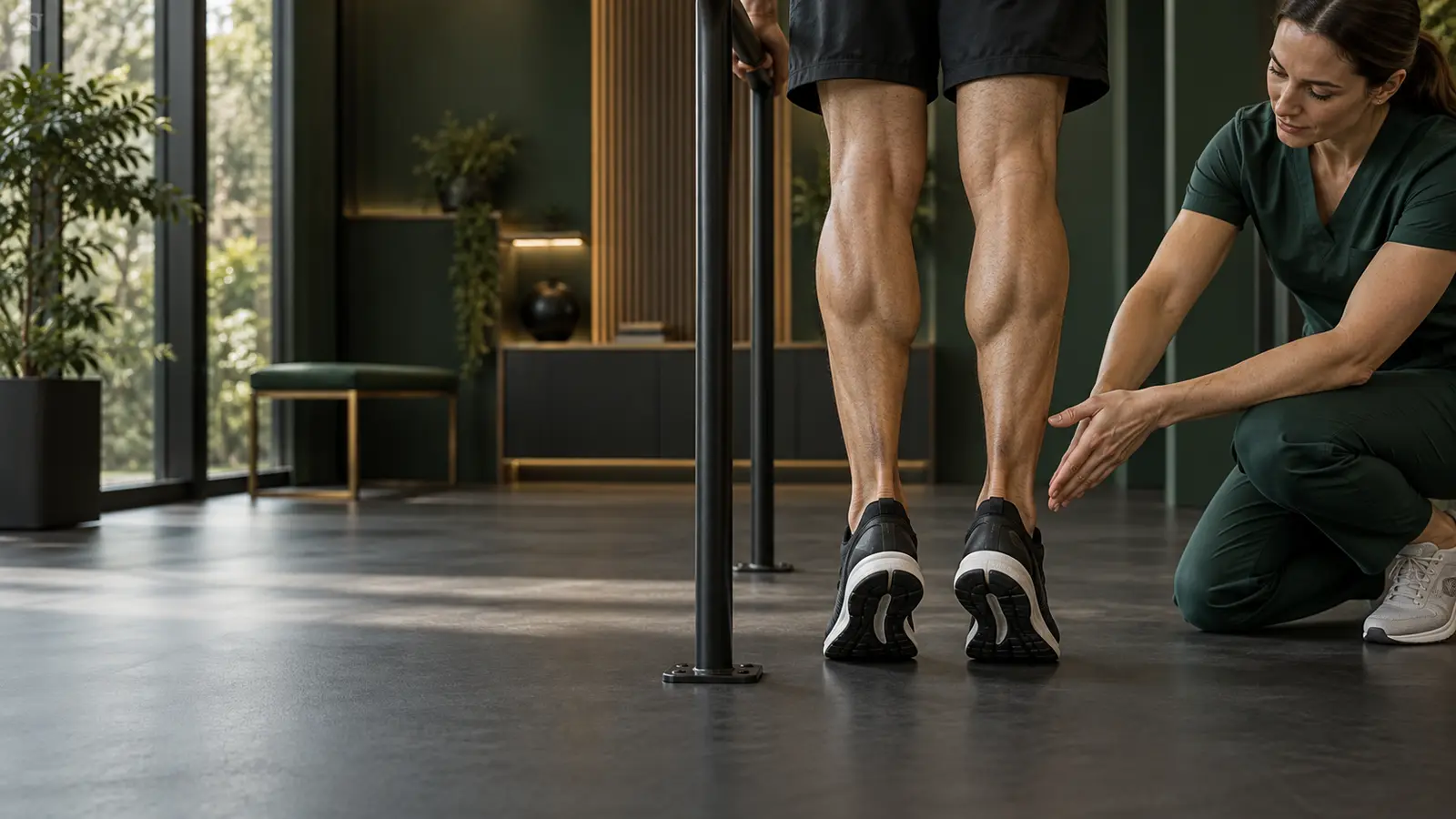
Achilles tendon pain is pain or stiffness at the back of the heel or low calf. Our care may help runners, walkers and active adults rebuild tendon strength step by step. We offer it at Transcending Health, 1445 Rio Road East in Charlottesville, VA.
The Achilles tendon links your calf muscles to your heel bone. It helps move force when you walk, climb stairs, run, jump or rise onto your toes. Too much repeated use can bother the tendon. But pain here is not always “tendonitis.” It may come from the middle of the tendon or where it attaches at the heel. It may also come from a nearby bursa, the calf, the ankle or another part. A sudden tear needs a different path than pain that builds slowly.
The American Academy of Orthopaedic Surgeons describes pain in the middle of the tendon and pain at the heel. Common signs include morning stiffness, pain with activity, thickening and swelling.
Stiffness in the morning or after sitting may ease as you move. Then it may come back after a hard day.
Running, hills, stairs, jumping or long walks may show that your tendon is not yet ready for the load you ask of it.
Calf weakness or pain may make heel raises, fast walking and changes of pace feel shaky.
A good plan starts with how the pain began, where it is and what makes it better or worse. Screening may look at how you walk, ankle motion and calf strength. It may also look at balance on one leg, recent training changes, shoes, past injury and your health.
You do not always need imaging. But we may refer you out if a tear, fracture, infection, inflammatory condition or another problem is possible.
In many cases, care uses tendon loading that builds over time instead of endless rest. You may start with a supported calf hold, a seated heel raise or another move you can handle. Over time, the plan can add weight, range and speed. It can also get closer to the tasks you need.
The 2024 APTA clinical practice guideline backs tendon-loading exercise as first-line care for pain in the middle of the Achilles. It also stresses clinical judgment. A peer-reviewed conservative-management review also puts gradual loading and changes to activity at the center of care.
These guides do not set one dose for everyone. Pain at the heel, a tendon that flares easily, low strength and sport goals may each need a different starting point.
A route that looks short on a map may have lots of ups, downs and uneven ground. That matters for runners, hikers and field-sport athletes. It also matters for anyone whose work keeps them on their feet across Charlottesville and Albemarle County.
Early on, the plan may use flatter routes, shorter bouts or low-impact workouts while strength builds. Later, hills and faster push-off can come back as planned steps, not surprise tests.
Transcending Health can help suitable clients set up a movement and recovery plan based on how they move now. Gradual exercise, learning about load and planning your return to activity stay at the center. Hands-on care or acoustic wave (SoftWave) sessions may be added when they fit your case.
No treatment can confirm a diagnosis, repair a tear or replace urgent medical care. If screening points to a problem outside our scope, we refer you out first.
Book a consult to talk about your symptoms, your activity and the service that best fits your needs.
View AppointmentsNo. Tendinopathy usually develops from repeated load and causes pain or stiffness; a rupture is a partial or complete tear that often follows a sudden push-off or jump. A pop, a new gap in the tendon, or sudden inability to push off requires prompt medical evaluation.
Sometimes activity can be modified rather than stopped completely, but the answer depends on pain, walking mechanics, injury location, training strength and whether a tear or another condition has been ruled out. Continuing running that causes limping or a substantial next-day decline is a sign to reduce load and seek guidance.
Not always. Many presentations can be assessed from the history and physical examination. Imaging may be useful when the diagnosis is uncertain, symptoms are severe or atypical, a rupture is suspected, or progress does not follow the expected course.
Progressive calf and tendon-loading exercises are commonly used, beginning at a tolerable level and advancing through greater resistance, range, speed and activity-specific demands. The exact exercise and depth should match whether symptoms are midportion or insertional.
Recovery varies with symptom duration, tendon location, current capacity, health factors and the demands of work or sport. Meaningful change often requires consistent load management and progressive exercise over weeks to months rather than a quick fix.
It may be considered as an adjunct for selected clients after screening, but it does not replace appropriate diagnosis, progressive loading or referral when warning signs are present. Suitability and response vary.
Seek prompt care after a sudden pop or snap, a visible or palpable gap, major swelling or bruising, inability to bear weight, or sudden loss of push-off strength. Fever, spreading redness, a hot swollen area, numbness or a cold or discolored foot also requires medical evaluation.
Book online or call our Charlottesville team. We can talk about the best starting point for your Achilles tendon pain.